


Forex Broker Solutions Market Overview (2026): Trends, Tools, and Infrastructure
Share this publication:
The forex broker solutions space you're operating in today looks nothing like it did five years ago. The foreign exchange market now processes an average of $9.6 trillion per day as of April 2026, making it the world's largest financial market – and the infrastructure required to compete inside it has grown just as dramatically. Whether you're running an established brokerage or in the process of launching one, understanding where the market stands right now is not optional. It's the difference between building something sustainable and building something that gets outpaced before it finds its footing.
The Forex Broker Solutions Have Become the Strategy
A few years ago, the tools you picked were largely operational decisions. Today, they're strategic ones. The brokerage landscape in 2026 is defined by maturity -- core asset access is widely available, and technology stacks are increasingly standardized. Growth now depends on operational precision.
What that means for you practically is that two brokerages can offer the same instruments, the same spreads, and access to the same liquidity pools, and still produce wildly different results. The gap shows up in how efficiently your systems talk to each other, how fast you onboard clients, and how clearly your team can see risk exposure in real time.
Modern brokerage technology solutions comprise an integrated ecosystem of tools -- trading platforms such as Trading Platform , DXTrade, and cTrader, CRM systems, and liquidity aggregation -- all working together rather than operating as isolated products.
Trading Platforms: What's Actually Being Used
Many forex and CFD brokers will be using the Trading Platform 5 in 2026. However, some brokers are considering the migration to more modern trading platforms such as cTrader (Spotware), DXtrade, or Match-Trader. The decision that you must make on which platform to use is going to depend on your target markets and the degree of customization that you require.
If you're creating a retail-oriented (as opposed to pro-trader) brand, Trading Platform 5 will likely continue to provide a robust foundation for your business. Trading Platform 5 continues to be the most widely used platform in the forex industry, and in 2026 that hasn't changed. Most traders already know how to use it, which removes a big barrier when they open an account with a new broker.
But familiarity isn't everything. cTrader is often chosen by firms that prioritize transparent execution and reliable platform operations. Its flexible architecture and extensive integration options make it a practical choice for companies looking to scale efficiently, with a broad set of APIs enabling connectivity to more than 100 established FX/CFD solutions.
If you're establishing a professional trading firm or creating a broker to cater to pro traders (i.e., highly tech-savvy), platforms like DXtrade can offer you a distinct competitive advantage. In the case of broker-niche firms (growth-oriented), the DXtrade platform provides a comprehensive product offering and accommodates more sophisticated account designs than Trading Platform 5. For prop trading firms, on the other hand, DXtrade provides the necessary flexibility to create client configurations such as defining evaluation criteria, scaling structure and trading restrictions.
The key point you should take away from this is that in 2026, a trading platform will no longer just be software -- but rather, it will be the very foundation upon which your brokerage is built. In fact, it will be the defining characteristic of all your relationships with clients throughout the life of your brokerage
Execution Infrastructure and the A/B-Book Reality
Behind every trade you process is an execution architecture that either works in your favor or quietly creates exposure. In 2026, most brokers will use hybrid models. Profitable traders are often routed to the A-book, while unprofitable flow may remain internalized.
This hybrid approach gives you flexibility, but it also demands that your risk management layer is genuinely built for it, not bolted on after the fact. Spreads, slippage, and execution speed your clients experience are all downstream of how your backend infrastructure is structured, and they notice when something is off.
Your liquidity bridge sits at the center of this. It determines how orders flow, how aggregation happens, and where your exposure lands. Getting this wrong is expensive. Getting it right is one of the quietest competitive advantages a brokerage can build.
Forex CRM: No Longer Just Client Management
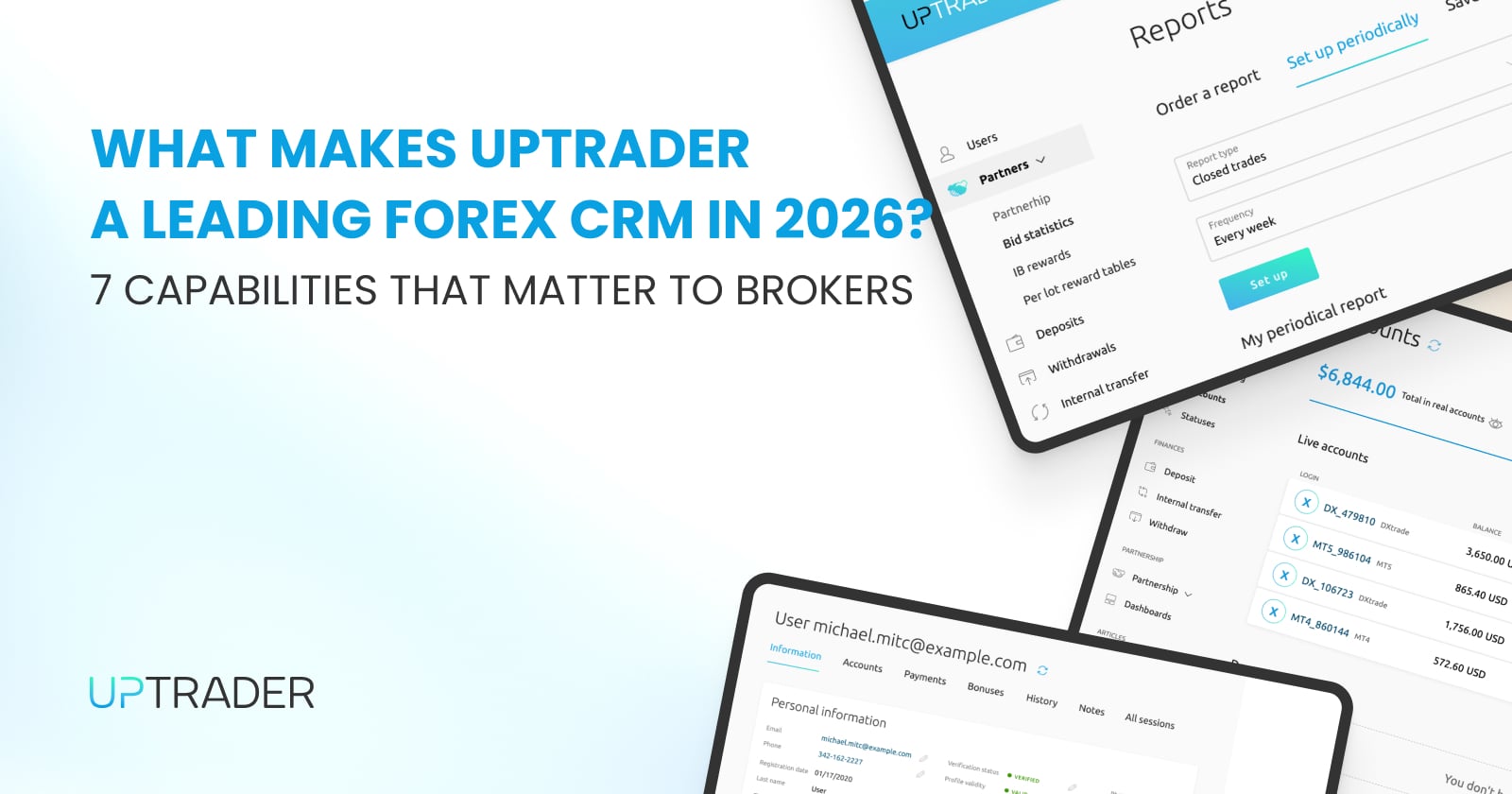
In 2026, a Broker CRM is no longer just a client database. A modern Forex CRM is a strategic infrastructure -- it connects marketing, compliance, IB networks, payments, and trading visibility into one coordinated environment.
If your CRM isn't natively integrated with your trading platform, you're already managing friction that doesn't need to exist. Your sales team is working off exported reports. Your compliance team is cross-referencing documents manually. Your IB commissions are being calculated outside the system. None of that scales.
Without this connection, brokerages operate through fragmented systems, forcing departments to rely on exported reports and manual reconciliation. The brokers pulling ahead in 2026 are the ones who've eliminated that fragmentation.
AI, Automation, and What They Actually Mean for You
You've probably heard more about AI in financial services this year than in the five years prior combined. But cutting through the noise matters. The AI systems that are being built and implemented today can analyze millions of data points in search of correlations between different markets, and detect potential signals that traders might miss. Moreover, the machine learning capabilities of these algos have progressed to a point where they can optimize themselves based on past historical forex pricing. This will help forex traders develop better trading strategies.
For brokerage firms, the biggest gains from AI technology will be in automating the onboarding and compliance process. The main technology providers for Forex trading companies are now adding compliance-based applications to their trading platforms. These types of applications are designed to automate the processes related to KYC verification, AML reporting, and trade monitoring.
Whether you are an institutional broker or a small broker, having to manually complete your compliance procedure is a risk and cumbersome for your brokerage. The regulations imposed by regulatory agencies are becoming tighter and more complicated every year and will likely continue this trend through 2026. Thus, companies need to ensure that they are in compliance with respective regulations regarding their document management systems, client onboarding processes and communication tracking processes.
Crypto Integration Is No Longer Optional
The cryptocurrency market exploded in 2026 and surpassed 200 billion dollars in market capitalization, and many of the top forex brokers in the world are now developing systems to support cryptocurrency trading in an effort to capture this fast-growing opportunity.
If your firm does not accept cryptocurrencies as a deposit method, or if your firm does not use cryptocurrencies to facilitate settlements, your firm will be missing out on a major section of the trading community, especially among traders in developing countries where access to traditional banking services is limited. By implementing crypto settlement systems, brokers (regardless of firm size) can provide instant settlements for cross-border transactions 24/7 and also combine these with fiat on-ramps used for funding traders' accounts.
Cloud, Scalability, and Infrastructure Decisions
Cloud computing has experienced a rough patch, with a portion of businesses moving back to in-house operations. However, the coming years will require rapid and seamless scalability, which is far too costly to implement on-site for most brokerages, fueling the growth and relevance of cloud environments.
The brokers who scaled fastest during volatile market windows in 2025 were the ones whose infrastructure could absorb the spike without degradation. Execution quality during high-volatility sessions is one of the most visible trust signals your clients evaluate, often without realizing they're evaluating it.
API Integration as a Competitive Layer
One of the most underappreciated parts of your technology stack is its API layer. API integration gives you the freedom and power to implement any third-party solution in your infrastructure and make the most of modern technology the market has to offer.
Whether you're connecting a custom risk engine, integrating a regional payment provider, or pulling in an external analytics dashboard, your API infrastructure is what makes it possible without rebuilding everything from scratch. The brokerages treating their API layer as a first-class part of their stack are the ones with the most flexibility going forward.
The Bottom Line for 2026
The forex broker solutions market in 2026 is not short on options. What it is short on is simplicity. You're operating in an environment where every layer of your stack -- platform, CRM, liquidity, compliance, payments -- needs to function as a coherent whole, not a collection of parts that technically work but create friction at every seam.
The brokerages winning right now are not necessarily the ones with the most tools. They're the ones whose tools actually talk to each other, whose teams have real visibility, and whose clients experience consistency whether they're trading on mobile at 2am or calling support in the middle of a volatile session.
Want a CRM but want to be sure what you get is the right product, request a tailored demo today so you know what you are getting into, no strings attached.