


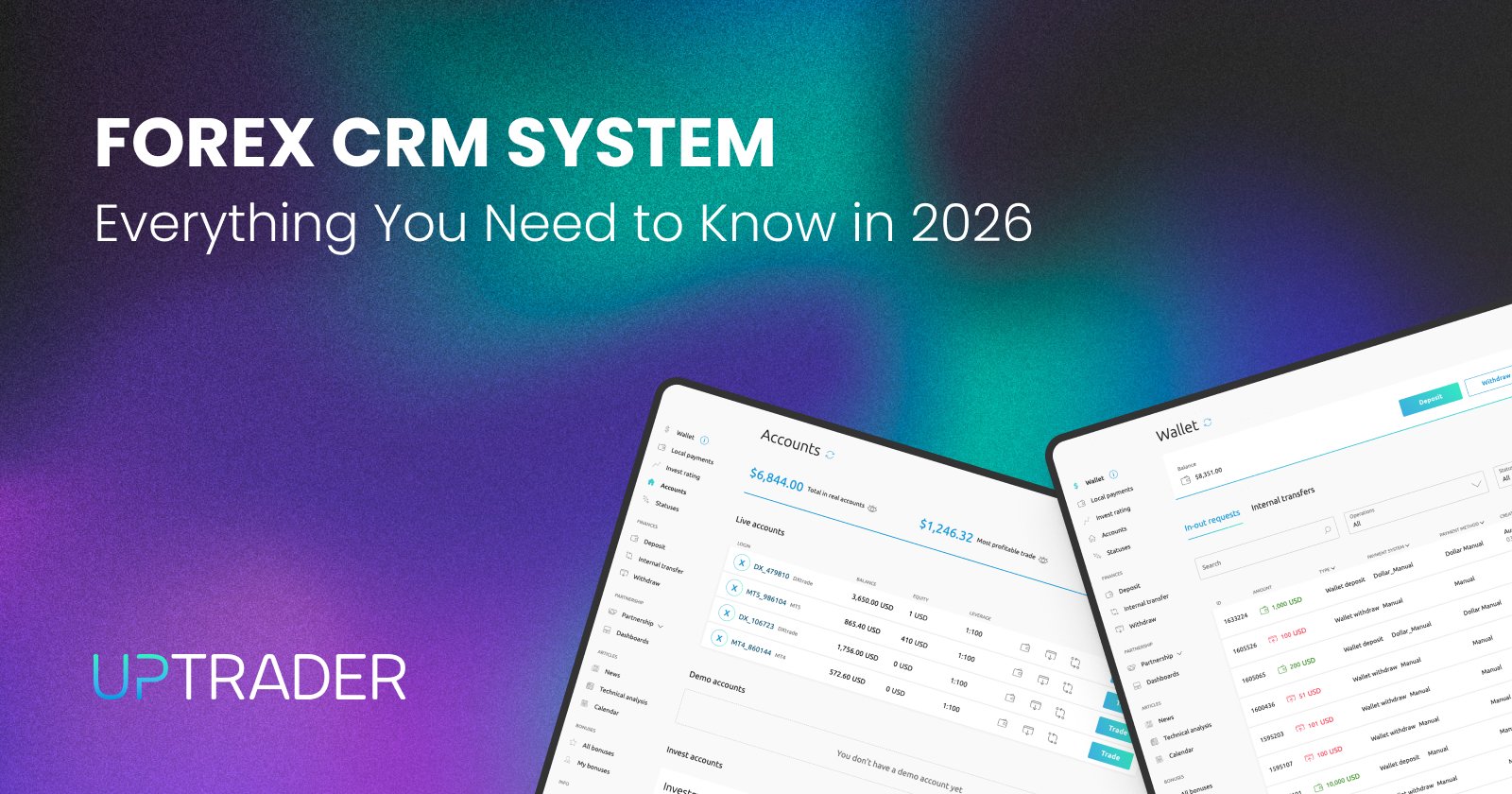
Forex CRM System: Everything You Need to Know in 2026
Share this publication:
If you stripped your brokerage down to the studs and removed the fancy branding, the sales floor, and the flashy marketing campaigns, what would be left? If the answer isn’t "a robust Forex CRM System," you are building on sand.
In 2026, the Forex CRM (Customer Relationship Management) system is no longer just a piece of software you buy to store client emails. It is the operating system of your existence. It is the difference between a brokerage that scales effortlessly and one that collapses under the weight of its own administrative chaos.
You might think you know what a CRM does. You might think it is just for your sales team to dial leads. But if you want to dominate the market this year, you need to understand the full anatomy of a modern brokerage ecosystem. This is your blueprint.
The Anatomy of a Modern Forex CRM System
To understand the system, you have to stop looking at it as a single tool. In 2026, a "CRM" is actually a triad of three distinct, powerful engines working in perfect sync. If one of these pillars is weak, the whole structure fails.
1. The Trader’s Room (Client Cabinet)
This is what your client sees. It is your digital storefront. In an era where UI/UX (User Experience) determines loyalty, this is where the battle is won or lost.
- The 2026 Standard: Your Trader’s Room must be a seamless, self-service portal. Clients should be able to open accounts, upload KYC documents, deposit funds via crypto or fiat, and transfer money between Trading Platform 5 and cTrader accounts without ever speaking to a human.
- The Critical Shift: It must be mobile-native. Not "mobile-responsive" as that is 2020 talk. It needs to feel like an app. If a client has to pinch-to-zoom to hit the "Deposit" button, they will close the tab and go to a competitor.
2. The Back Office (The Admin Panel)
This is what you see. It is the control tower.
- The Function: This is where your compliance team approves documents, where your finance team reconciles payments, and where your risk team monitors exposure.
- The 2026 Standard: Automation is the name of the game. A modern Back Office automatically categorizes clients based on risk profiles, flags suspicious laundering attempts (AML), and routes support tickets to the right department instantly. If your team is manually copy-pasting data from a payment provider to your trading platform, your system is obsolete.
3. The Partnership Portal (IB System)
This is what your affiliates see.
- The Reality: You know that organic traffic is expensive. Introducing Brokers (IBs) are the lifeblood of volume for 90% of brokers.
- The 2026 Standard: Your CRM must handle multi-tier rebate structures automatically. If you have a Master IB with 50 Sub-IBs under them, the system must calculate and distribute the commission splits in real-time. If an IB has to wait until the end of the month for a spreadsheet report, they will leave you for a broker who pays them daily.
The Forex CRM Connectivity Ecosystem
A Forex CRM in isolation is useless. Its power comes from what it connects to. In 2026, your Forex CRM is the central hub that plugs into the wider financial world.
The Trading Platforms Your CRM must have deep, two-way integration with the majors: Trading Platform 4/5, cTrader, and the rising stars of web-based trading. "Two-way" is the key phrase here. When a client changes their leverage in the Client Cabinet, it must update in Trading Platform 5 instantly. When a Stop Out happens in cTrader, your CRM must record it immediately for your sales team to see.
The Payment Gateways (PSPs) This is where the money is. A top-tier CRM acts as a payment aggregator. It connects to dozens of PSPs (Payment Service Providers). Why? Because redundancy is survival. When your primary credit card processor goes down (and it will), your CRM should intelligently route traffic to your backup provider without the client ever knowing there was a glitch.
VoIP and Communications Your sales team lives on the phone. Modern CRMs integrate directly with VoIP systems. When a known client calls, their profile pops up on the agent's screen before they even pick up. The call is recorded, transcribed by AI, and logged in the client's timeline automatically.
The Role of AI in Forex CRM: Moving Beyond the Hype
By now, you are tired of hearing about "AI." But in the context of a Forex CRM, AI isn't about generating text. It is about generating revenue.
Lead Scoring & Routing Your marketing generates 1,000 leads. 900 of them are tire-kickers, while 100 are serious. A human cannot filter this fast enough. 2026 CRMs use behavioral scoring. Did the lead verify their email? Did they click the "Deposit" page? Did they download the platform? The system scores them and routes the "Hot" leads to your best closers instantly, while the "Cold" leads go into an automated email nurture sequence.
Retention Algorithms This is your safety net. The system analyzes trading patterns. If a regular trader suddenly stops, or if their trade size drops significantly, the CRM flags a "Churn Alert." Your retention team gets a notification to call the client because there is a high risk of leaving. You solve the problem before the client withdraws their funds.
Forex CRM Security and Compliance: The Shield
You are holding people's money. Trust is your only currency.
Data Sovereignty In 2026, regulators are stricter than ever. Your CRM must allow you to host data in specific jurisdictions if required. If you operate in Europe, GDPR isn't a suggestion. It is the law. The system needs "Right to be Forgotten" protocols built-in, allowing you to anonymize client data with one click if requested.
Access Control Internal theft is a real threat. A robust CRM has granular permission settings. Your junior sales guy should not see the "Export All Clients" button. Your support agent should not have the ability to approve withdrawals. The system logs every click, every view, and every edit. If data leaks, you know exactly who did it.
The Cost of Forex CRM System Ownership
Finally, let’s talk money. You will see three pricing models:
- SaaS (Monthly Fee): Great for starting. Low upfront cost, but you pay forever.
- Volume-Based: You pay a fee per active account or per lot traded. Avoid this if you plan to scale because it punishes your success.
- Perpetual License (Self-Hosted): You buy the code. High upfront cost ($50k+), but you own it. You need your own IT team to manage the servers.
The Hidden Costs Don't look at the sticker price. Look at the setup fee, the training costs, and the "custom development" hourly rate. If the vendor charges you $200/hour every time you want to change the color of a button, the cheap monthly fee is a trap.
Conclusion and Final Thoughts
The Forex CRM market in 2026 is mature, sophisticated, and crowded. But remember this: The software will not save a bad business model, but a bad software choice will absolutely kill a good one.
You need a system that is invisible. It should work so smoothly that your clients never think about it, and your team never complains about it. It should be the silent engine that powers your growth.
Don't settle for a glorified spreadsheet. Demand a Command Center.
Don't let outdated technology cap your potential. Join the hundreds of successful brokers already using UpTrader to dominate the financial markets.