





What a Forex CRM Actually Does Inside a Real Brokerage in 2026
Share this publication:
Most content about forex CRM systems reads like a vendor brochure. You get a list of features, a few integration logos, and a closing pitch. What you rarely get is an honest picture of what the forex CRM actually does once it is live inside a brokerage with real clients, real compliance deadlines, and real operational pressure.
That gap matters. The features tell you what the system claims to do. What you need to understand is how it behaves when your compliance team is processing 200 KYC submissions on a Monday morning, when your finance department is reconciling deposits across six payment providers, or when your IB manager needs to explain a commission discrepancy to a partner who is threatening to move their network to a competitor.
This is not a comparison guide. It is a walkthrough of what a forex CRM actually touches inside a working brokerage in 2026, told from the perspective of the teams who depend on it every day.
The First Thing That Happens in a Forex CRM: A Lead Arrives
Before a client ever funds an account, they are a lead. They clicked an ad, landed on your registration page, and submitted a form. That moment is the first time your forex CRM does anything, and what it does in the next 30 seconds sets the trajectory for whether that lead converts or disappears.
In a well-configured brokerage forex CRM, the registration triggers an automated sequence. The lead is scored based on the information submitted, country of residence, declared experience level, and acquisition source. It is assigned to a sales agent based on configurable routing rules. Leads from the UAE go to your Dubai desk. High-net-worth indicators route to a senior account manager. First-time traders go into a nurture sequence before anyone calls them.
This happens without a human touching anything. The alternative, which still exists in brokerages running generic tools, is a spreadsheet export that someone reviews manually every few hours. By the time that review happens, the lead has registered with whoever responded first. Industry benchmarks suggest that automated CRM workflows can reduce onboarding time by up to 60 percent. That is the difference between a funded account on day one and a dead lead by day three.
Onboarding and KYC: Where Most Brokerages Lose Clients
Once a lead registers, the forex CRM transitions into onboarding mode. The client uploads identity documents, proof of address, and completes any required suitability questionnaires. This is where most brokerages experience their first major operational bottleneck.
Here is what happens inside a CRM that was built for this workflow. The client uploads a passport photo and a utility bill through the trader portal. The automated verification checks run through the client relationship management database. Provided that the documentation is clean, legible, and in agreement with the identified account data (i.e., registration data), the submission would be auto-approved and automatically clear the client to deposit. If there is a discrepancy, a blurry image, an expired document, or a name mismatch, the submission routes to a manual review queue with the specific issue flagged so the compliance officer knows exactly what to check.
Now here is what happens when the forex CRM was not designed for this. The compliance officer opens each submission manually, downloads every document individually, cross-references it against the registration form in a separate tab, makes a judgment call, and updates the status in yet another system. Multiply that by 150 submissions on a busy day, and your compliance team spends its entire week triaging instead of focusing on edge cases that actually require human judgment.
The CRM does not replace your compliance team. It gives them back the hours they are currently wasting on routine approvals so they can focus on the decisions that matter.
What the Sales and Retention Teams Actually See
Once a client is verified and funded, the forex CRM shifts into its ongoing operational role. This is where it functions as the daily interface for your sales and retention teams, and the depth of what they can see determines how effectively they can do their jobs.
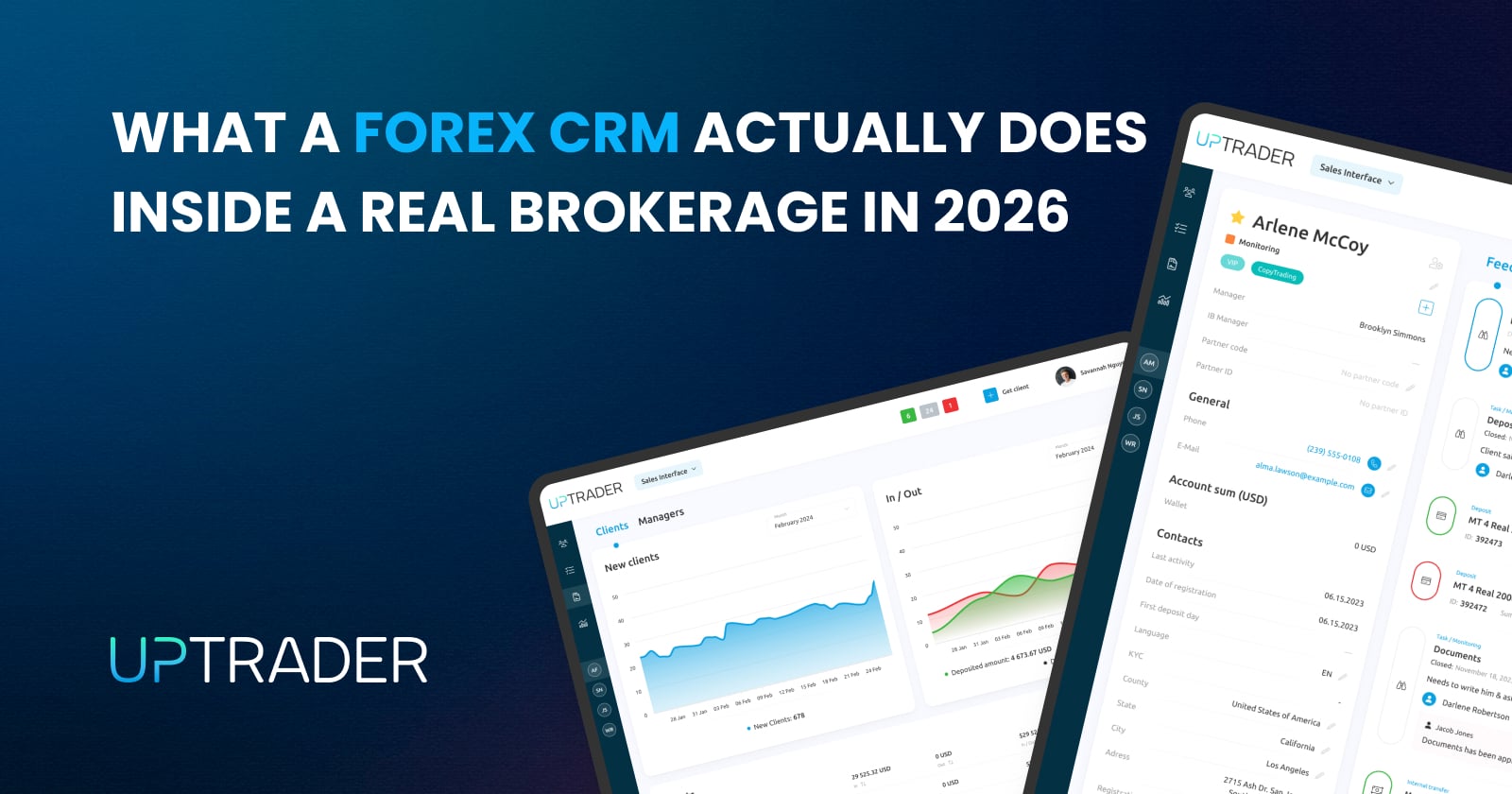
In a purpose-built forex CRM with deep trading platform integration, an account manager opens a client profile and sees everything in one place. Current balance. Open positions. Recent deposit and withdrawal history. Trading frequency over the last 30 days. IB attribution. Communication history. Support tickets. Compliance status. All of it, in a single view, without toggling between systems.
This visibility is what allows your team to act rather than react. A retention agent notices that a previously active trader has not placed an order in 12 days. The forex CRM has already flagged the account based on an inactivity threshold. The agent can see that the client's last three trades were losses and their balance dropped 40 percent in a week. That context changes the conversation entirely. Instead of a generic "we miss you" email, the agent can reach out with something relevant. That is the difference between a retention workflow that feels automated and one that actually retains.
Without trading platform integration, your retention team is guessing. They send the same templated message to every dormant account and wonder why the reactivation rate stays flat.
How the Finance Team Uses It
Payment operations are one of the most underappreciated functions inside a brokerage, and the forex CRM is where your finance team lives. Every deposit request, every withdrawal approval, every internal transfer, and every refund flows through the forex CRM's financial layer.
What your finance team needs is a single-wallet ledger where every fund movement is recorded as a discrete, traceable event. A $5,000 credit card deposit creates a ledger entry tied to the client identity, the PSP, the timestamp, and the approval status. A $2,000 withdrawal request three days later routes through an approval workflow that checks compliance status, verifies AML conditions, and either auto-approves or escalates to manual review.
At month-end, your finance team matches every fund movement against PSP records. Brokerages that track balances per account or per PSP independently end up with fragmentation that turns reconciliation into a multi-day investigation. The ones running a clean single-wallet architecture close their books in hours. The forex CRM also handles the operationally critical edge cases that quietly consume your finance team's week: failed deposits needing status updates, chargebacks requiring documentation trails, and refund requests tied to specific transactions.
IB Commission Management: The Quiet Complexity
Introducing Broker management looks simple on the surface and becomes enormously complex at scale. An IB refers clients and earns commissions based on their trading activity. Straightforward with five IBs and 50 referred clients. Entirely different when you have 200 IBs, multi-tier sub-IB hierarchies, and negotiated commission structures that vary by partner, by region, and by product.
Inside the forex CRM, your IB module maps every partner relationship, tracks every referred client's trading activity in real time, computes commissions based on confirmed trade data, and settles payouts automatically. When an IB logs into their dashboard, they should see their network, their referred clients' activity, and their earned commissions without contacting your team for a manual report.
The operational risk of getting this wrong is significant. Incorrect calculations lead to payout disputes. Delayed settlements erode partner trust. Opaque reporting pushes high-performing IBs toward competitors who offer better visibility.
Compliance as a Living Process
Compliance is not a one-time event that happens at onboarding. Inside a real brokerage, your forex CRM manages compliance as an ongoing process that touches the client record at multiple points throughout their lifecycle.
A client's KYC documents expire and the forex CRM flags the account for re-verification. A transaction pattern triggers an AML alert and the CRM routes it to the compliance team with full history attached. A client from a newly sanctioned jurisdiction logs in and the CRM applies updated restriction rules automatically. Every one of these events generates an audit trail: who reviewed it, when, what they decided, and what evidence supported that decision.
When a regulator asks you to demonstrate your compliance process for a specific client, your CRM should produce that entire trail in seconds. If your compliance officer needs to reconstruct it from email threads and spreadsheets, you have a governance gap that will cost you during an audit. The brokerages that embed compliance into their CRM's daily operations are the ones that pass audits cleanly and scale into new markets without rebuilding their workflows from scratch.
Conclusion
A forex CRM in 2026 is not software your team logs into occasionally. It is the system they work inside all day, every day. It is where leads become clients, where compliance gets enforced, where payments get processed, where partners get paid, and where your leadership team gets the operational visibility they need to make decisions before problems escalate.
When the forex CRM underperforms, everything underperforms. Onboarding stops. Deposits sit unmatched. Your sales team loses access to client records. Your IB partners cannot see their commissions. It is not one department that feels the impact. It is all of them, simultaneously. That is why uptime, reliability, and architectural resilience matter far more than any individual feature on a vendor's checklist.
Choose your forex CRM the way you would choose the foundation of a building. Not based on how it looks in a presentation, but based on whether it can hold the weight of everything you plan to build on top of it.
UpTrader provides a purpose-built forex CRM and back-office platform that integrates trading data, client lifecycle management, IB operations, payment processing, and compliance workflows into a single operational system.
Learn more about the Forex CRM and get a tailored demo today and see how UpTrader works inside real brokerages