


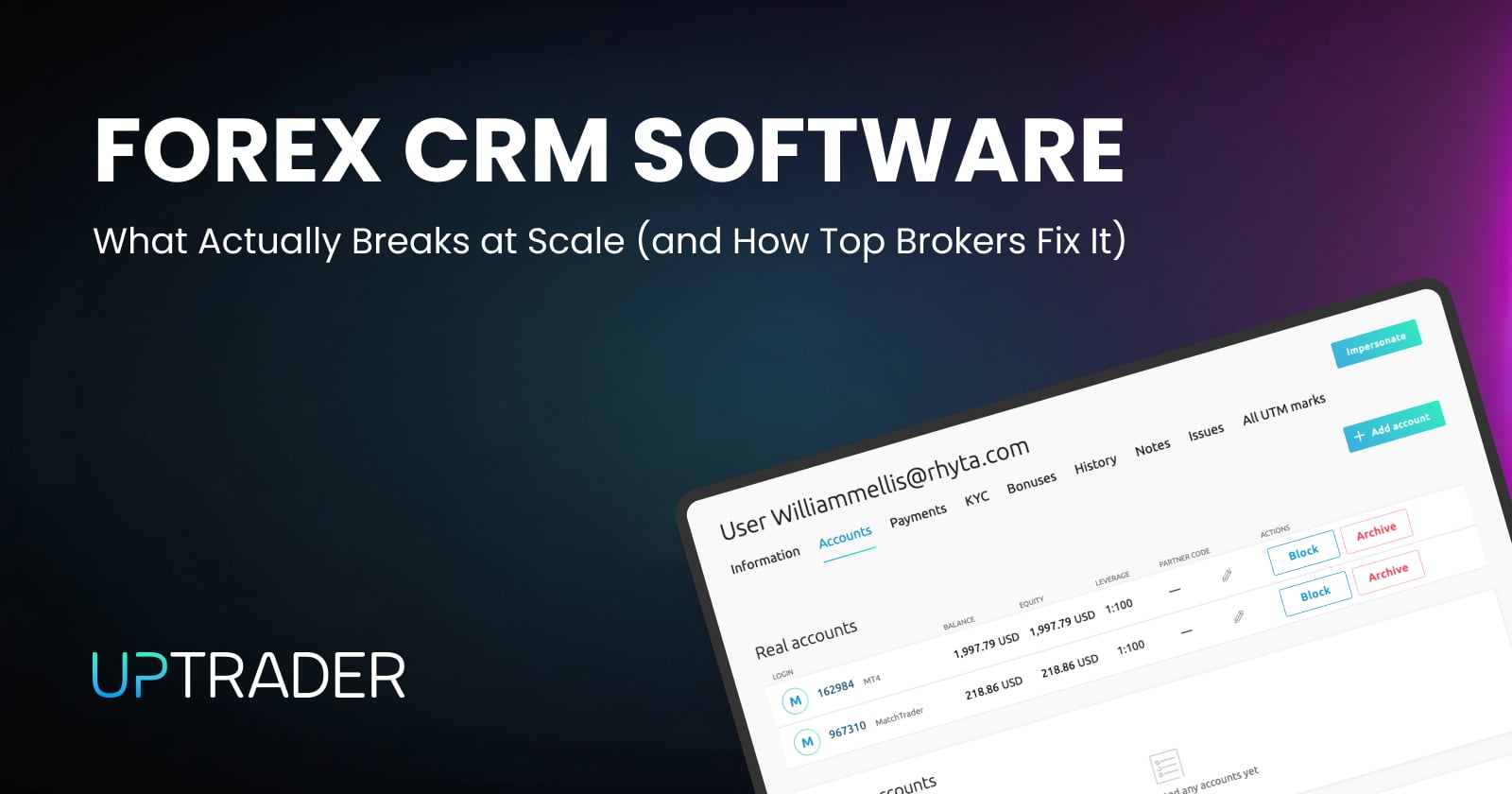
Forex CRM Software: What Actually Breaks at Scale (and How Top Brokers Fix It)
Share this publication:
There is a version of this story almost every growing forex brokerage lives through. The early infrastructure holds up fine at 200 clients. Operations feel manageable, the team knows where everything lives, and the tools in place get the job done without too much friction. Then the client base crosses 1,000, the IB network expands into multiple tiers, regulators start asking harder questions, and suddenly the whole setup starts to buckle. What breaks is rarely the trading platform or the liquidity bridge. What breaks is the Forex CRM software, or more precisely, the fact that it was never built for what the business actually became.
This is not a product failure story. It is an architecture story. And understanding where the fractures appear, and why, is more useful than any feature checklist.
Why Generic CRMs Stop Working in Forex
If your brokerage launched on Salesforce, HubSpot, or a similar general-purpose platform, you probably already know the wall. Generic CRM systems are built for contact management, pipeline tracking, and communication logging. They were not designed to connect live Trading Platform 4/5 account data, automate IB commission structures tied to trading volume, or produce the kind of audit-ready compliance records that regulators in the UK, Cyprus, or Australia expect during an examination.
The gap becomes structural, not just functional. Your compliance team ends up chasing KYC document expiry dates in a spreadsheet. Your operations team exports trading data manually to reconcile commissions. Your IB partners receive payouts that do not match the numbers they see in their dashboards. Each of those gaps is a workaround, and workarounds compound into operational debt as volume grows.
According to the forex CRM market data published by Brokeret, the specialized forex CRM market was valued at over $530 million in 2025, with projections to reach $950 million by 2033. That growth reflects brokerages actively moving off generic tools as they discover what purpose-built infrastructure actually does differently.
Forex CRM Software: Four Places Scale Exposes Weakness
IB Commission Logic At Volume
Introducing brokers drive somewhere between 40 and 70 percent of funded account acquisition for most retail forex brokerages, according to operational data cited by DivulgeTech's 2026 IB portal guide. That is your most important growth channel, and it is also the first place CRM infrastructure fails under pressure.
The math is unforgiving. Research published by FYNXT illustrates the problem directly: if a brokerage accidentally overpays just $2 per lot across 20,000 monthly lots, the annual revenue loss reaches $480,000. Manual commission tracking using spreadsheets or exported reports cannot catch that kind of drift consistently, especially once the IB structure grows beyond a single tier. Industry practitioners note that manual commission calculation typically becomes unsustainable beyond 50 active IBs, at which point the reconciliation load exceeds what operations teams can handle without errors.
What purpose-built forex CRM software does is connect commission logic directly to the Trading Platform 4/5 Manager API, so every trade that flows through the platform updates IB accruals in real time. Payouts are automated against predefined rules, minimum thresholds, and approval workflows. IBs see their running commission balance in their portal without waiting for end-of-month reconciliation. Disputes drop because the numbers are traceable to a specific trade, not reconstructed after the fact.
KYC And Compliance Workflows Under Regulatory Scrutiny
Regulators across Europe, Asia, and the Middle East are running more sophisticated audits. What they are looking for is not just whether your compliance records exist, but whether the controls are applied consistently, whether approvals are documented, and whether the audit trail is complete from onboarding to withdrawal.
When KYC document collection lives in email threads, document review happens in a separate portal, and approval decisions are logged in a shared spreadsheet, there is no single source of truth. Brokers are forced to reconstruct compliance evidence retroactively, which is both time-intensive and legally exposed. A purpose-built forex CRM brings document upload, review status tracking, identity verification integration with services like SumSub or Onfido, jurisdictional logic, and the full audit trail into one environment. Every decision is timestamped, attributed to a specific team member, and retrievable during an audit without manual data assembly.
Payment Reconciliation Across Multiple PSPs
Multi-region brokers commonly manage 8 to 12 active payment service provider connections, each with its own webhook format and reconciliation logic. When deposits and withdrawals are processed through PSP dashboards and then reconciled manually against the CRM, any mismatch between the two systems creates what infrastructure analysts have described as "split-brain data," where two systems hold conflicting records of the same transaction.
The structural fix is an event-based internal ledger, where every fund movement is recorded as a ledger event tied to a single client identity and balance history. Reconciliation becomes a pull from the ledger rather than a manual comparison between systems. Withdrawal approvals, refund handling, and chargeback evidence all trace to the same record. Without that architecture in place, reconciliation becomes, as one industry guide puts it, a weekly fire drill.
Reporting That Tells You What Happened, Not What You Hope Happened
As client volume rises, brokerage leadership needs reporting that connects the full event sequence: lead acquisition, KYC completion, first deposit, trading activity, funding behavior, and IB attribution. Without a unified event model in the CRM, each of those data points lives in a different system, and any summary report requires manual assembly across tools.
The result is that management decisions get made on narrative rather than data. You know roughly what is happening, but you cannot drill into why a specific cohort churned, which IB source produces the highest lifetime value, or where in the onboarding funnel clients are dropping off. Purpose-built forex CRM software is designed to answer those questions directly, because the full client lifecycle is recorded in one place.
How Top Brokers Are Fixing It
The brokerages that scale without rebuilding their operations from scratch tend to share a few structural choices.
They treat the CRM as their operational core, not a sales tool. In 2026, the leading forex CRM providers, including UpTrader, FXBO, B2Core, Syntellicore, and others, are positioning their products as what Finance Magnates has called a "broker OS," meaning the system that connects acquisition, compliance, payments, trading platform data, and IB management in one unified layer. Brokers who adopt this model stop running parallel systems that require manual synchronization and start operating from a single source of record.
They automate the processes that break at volume. The specific workflows that collapse under manual management are predictable: IB commission calculation, KYC document review queues, deposit and withdrawal approvals, and trading inactivity alerts for retention. A mature forex CRM automates all of these through configurable workflows, role-based approval logic, and scheduled processing rules. Staff capacity gets redirected from reconciliation to client relationships and strategic decisions.
They evaluate scalability before they need it. One of the most common costly decisions in the brokerage lifecycle is switching CRM providers mid-growth. That transition involves data migration with compliance implications, IB commission logic that has to be rebuilt in a new system, retraining across compliance, sales, and operations teams, and a period of reduced visibility while the new system is validated. Brokerages that assess infrastructure scalability early, including per-client fee structures that do not erode margin as the client base grows, avoid that disruption.
What to Evaluate Before You Choose
If you are currently evaluating forex CRM software, or considering whether your existing system can carry you through the next stage of growth, the capability gaps worth testing for are specific.
Can the system calculate IB commissions across at least three hierarchy levels in real time, without manual reconciliation? Does it integrate directly with your trading platform via the Manager API, or does it rely on periodic data exports? Is the KYC workflow self-contained, with document management, verification status tracking, and audit trail inside the CRM itself? Does the payment layer use an event-based ledger, or does reconciliation require comparison against external PSP records? And critically, when you ask the system who approved a specific withdrawal, which compliance checks ran, and when, can it answer that question immediately?
If the answer to any of those is a workaround, that workaround is a liability. It may not cause problems today. But at the volume where those questions become urgent, manual processes do not hold.
The Infrastructure Decision Is an Operational One
The forex CRM software market has matured to the point where the technical features across leading providers are broadly comparable at the surface level. What separates platforms that support growth from those that block it is not the feature list. It is whether the architecture was designed for the operational reality of a regulated, multi-region, multi-tier forex brokerage, or whether it was designed for something simpler and retrofitted to fit.
Your CRM is not a support tool. At scale, it is the system that determines whether your compliance team can operate defensibly, whether your IB partners trust the payouts they receive, and whether your leadership team makes decisions based on accurate data. Getting that infrastructure right before you need it is considerably less expensive than fixing it after the cracks appear.
Want to level up but are not sure? Request a tailored demo from UpTrader so you know what you are getting into.