





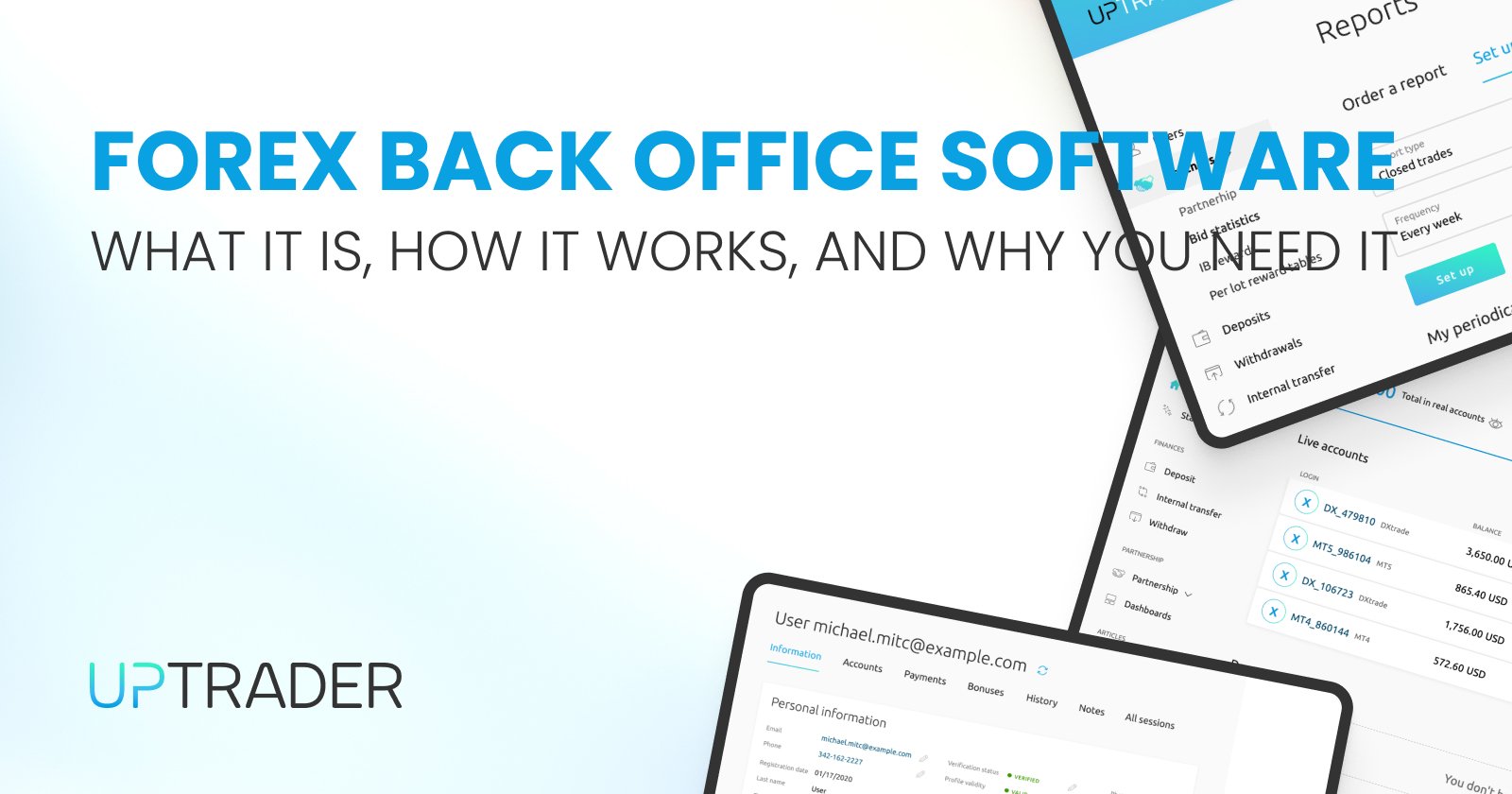
Forex Back Office Software Explained: What It Is, How It Works, and Why You Need It
Share this publication:
If you run — or plan to run — a Forex brokerage, your back office is where the real business happens. Traders see platforms and charts. You see risk, cash flow, compliance, and operational pressure. Forex back office software is the system that keeps all of that under control. Without it, growth becomes chaotic, decisions are delayed, and compliance turns into a constant fire drill.
This article breaks it down clearly and practically. You’ll understand what Forex back office software actually is, how it works behind the scenes, and why it’s no longer optional if you want to scale responsibly.
What Is Forex Back Office Software?
Forex back office software keeps brokerage operations running smoothly. It sits behind the trading platform and tools that interact with clients. It gives you visibility and control over company accounts, transactions, risks, compliance, reports, and internal workflows.
In other words: The trading platform handles the trade executions The CRM handles relationship management The back office handles the business logic that keeps everything safe, compliant and profitable.
It transforms unprocessed trading activity into structured, auditable data that you can act on.
Why The Back Office Matters More Than You Think
Many brokers appreciate the back office early on. At low volumes, dealing with spreadsheets and manual checks can feel manageable. But when deposits go up, the number of clients increases, and regulators start asking questions, the problems become glaring.
Without good back office software you are looking at:
- In delays on approved account withdrawals
- Inconsistencies with account data
- Poor insight on client risk
- Unchecked compliance
- Manual management reporting shortcomings
Each of these issues decreases trust, reputation, and profits. A back office that is running smoothly, helps brokers and keeps them safe.
How Forex Back Office Software Works
At its core, back office software connects multiple systems and turns them into a single operational framework.
Data Aggregation And Synchronization
Back office staff access data from trading platforms, payment systems, and customer data systems.
They check for: account balances and equity, open and closed positions, deposits and withdrawals, margin levels, and risk exposure.
Instead of juggling several applications, your staff sees everything in one, updated in real time, or near real time.
Account And User Management
From the back office you manage:
- Status of client accounts
- Trading restrictions
- Account categorization and leverage privileges
- Roles and access levels for internal users
This means that sales, support, risk, and compliance each see only what is relevant to them, which minimizes mistakes and internal exposure.
Risk Monitoring And Alerts
Your back office system does not wait for risk to happen. It monitors client trading and activity to help you:
- Identify abnormal trading patterns
- Flag risky accounts
- Monitor for margin calls and stop-out events
- Set alerts for thresholds that you control
This visibility helps you to address issues before they escalate.
Forex Back Office Key Components You Should Expect
Not every back office system is the same. Focus on these pillars when evaluating core systems.
Client And Account Management
Visibility is key across each client and account including:
- Account history and modifications
- Linked records and verification statuses financial records
- Trading activity summaries
Everything should be available via one streamlined interface.
Financial Operations Control
Deposits and withdrawals are critical and sensitive operations. Back office solutions allow you to:
- Review and authorize actions
- Set automated or manual transaction
- Controls and monitor payment statuses
- Keep comprehensive transaction records
Reduces the likelihood of fraud while expediting legitimate requests.
Compliance And Audit Tools
Transparency is a must while regulatory requirements differ by geography.
Strong back offices offer: immutable audit trails activity history for every account, exportable regulatory reports and role-based access auditing
When audits come you’re prepared instead of panic scrambling
How The Forex Back Office Supports Compliance
Compliance is not just about onboarding. It’s an ongoing operational responsibility.
Back office software helps you maintain compliance by:
- Tracking document validity and updates
- Monitoring suspicious financial behavior
- Recording internal actions taken on accounts
- Generating compliance-ready reports
Instead of relying on memory or manual processes, you operate with structured, traceable data. That alone can reduce regulatory risk significantly.
The Connection Between Forex Back Office And CRM
Your CRM manages relationships. Your back office manages reality.
When these systems are connected:
- Sales teams see accurate account status
- Support teams respond with full context
- Compliance teams access verified data
- Management sees real performance metrics
Disconnected systems create blind spots. Integration creates clarity.
Why Back Office Software Improves Decision-Making
Good decisions depend on good data. Back office software turns raw activity into insight.
You gain access to:
- Client profitability analysis
- Trends of deposits and withdrawals
- Risk exposure by segment or region
- Operational bottlenecks
This helps you to make decisions about marketing spend, leverage policies, onboarding rules, and staffing, instead of just blindly constructing these rules.
Scalability: The Silent Advantage
Operational complexity grows faster than client numbers. More trades, more payments, more regulations, more exceptions. Your brokerage grows.
Back office software allows you to scale without chaos by:
- Streamlining workflow
- Standardizing workflow
- Automating repetitive checks.
- More manual processes than your previous scale.
Maintaining consistent controls. Instead of overwhelming you, growth becomes manageable.
Common Mistakes Brokers Make Without A Proper Forex Back Office
The cost of weak infrastructure is:
- Approving withdrawals without context
- Losing timeout of report arching
- Missing early signs of abusive trading
- Granting excessive access to internal users
- Reacting to problems instead of preventing them
- Each mistake compounds over time.
A structured back office minimizes these issues.
How To Evaluate Forex Back Office Software
When you’re reviewing options, don’t focus only on features. Focus on fit.
Ask yourself:
- Does this system reflect how my brokerage actually operates?
- Can workflows be customized without heavy development?
- How transparent are logs, permissions, and reporting?
- Can the system scale with increased volume?
- How well does it integrate with existing tools?
A back office should adapt to your business — not force you to adapt to it.
Implementation: What To Expect
Rolling out new back office software is an example of a business process change, not a technical one. Examples of best practices include:
- Mapping out workflows prior to implementation
- Structuring and cleansing data
- Training people in your organization by role on your new software
- Using automation in a limited way to start
- Refraining from monitoring your new software’s
- KPIs until a certain period has elapsed after going live
With new software implemented correctly, your operations and workflows can improve quickly and without disrupting your business as usual.
Why You Need Forex Back Office Software Today
The Forex market has become more competitive, regulated, and data-driven than ever. Fragmented tools and manual processes increase your backwardness.
With effective back office software, you will have:
- Operational clarity Better risk control
- More efficient and secure processes
- Confidence in meeting compliance requirements
- Increased scalability It’s not just about managing trades.
It’s about running your brokerage like a serious financial business.
Final Thoughts
Forex back office software is no longer the infrastructure you add “later.” It’s the foundation that supports everything else — from client trust to regulatory survival.
If you want control instead of chaos, insight instead of guesswork, and growth without constant operational stress, a robust back office system isn’t optional. It’s essential.
When you understand what it does, how it works, and why it matters, the decision becomes straightforward.
Book a demo today — See how UpTrader can turn your brokerage into a lean, growth-ready machine.