


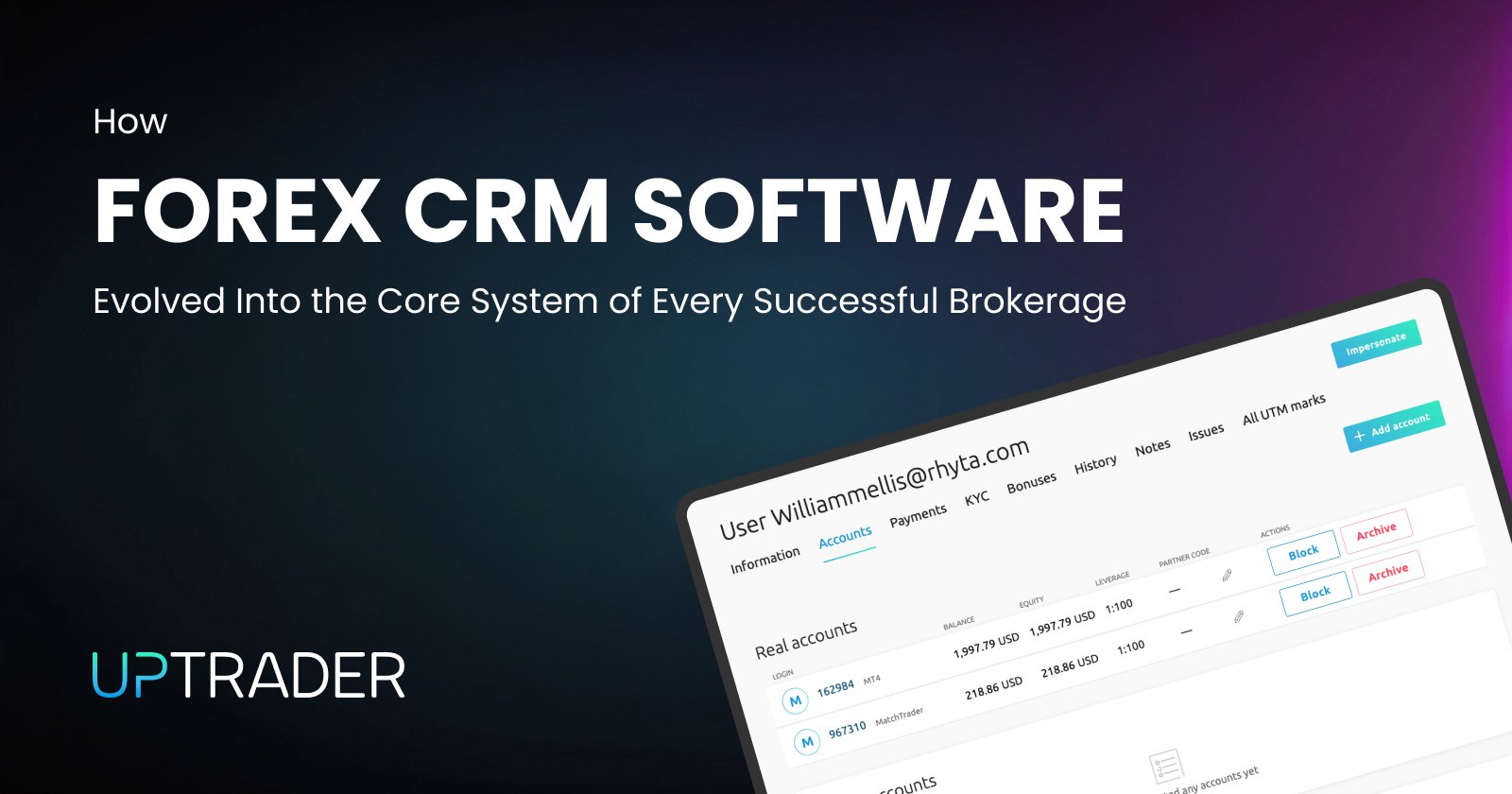
How Forex CRM Software Evolved Into the Core System of Every Successful Brokerage
Share this publication:
You no longer build a successful brokerage around a trading platform alone. In today’s market, the platform executes trades — but the CRM runs the business. Beginning as simplistic client software, the Forex CRM Software is now the operational backbone critical to every competitive forex brokerage.
As you think about 2025, if your CRM is not the hub of client acquisition, risk management, trader retention, and revenue scaling, you are already behind. This is not evolutionary. It is regulatory. It is competitive. It is the client. It is a complex brokerage operation. Understanding the forex CRM software from this perspective and how it now sits at the zenith of brokerage operations will help you make better infrastructure predictions.
The Early Days: Forex CRM Software as Basic Contact Databases
Originally, Forex CRM Software served a very narrow purpose. You used them to store client names, email addresses, and maybe a few notes from sales calls. They weren’t built for trading businesses — they were generic customer management tools borrowed from other industries.
At that stage, your real operations lived elsewhere:
- Sales teams tracked leads manually
- Finance teams handled deposits in spreadsheets
- Support worked from inboxes
- Risk teams relied on disconnected reports
The CRM was passive. It didn’t drive decisions. It didn’t automate workflows. It simply held data.
That model stopped working as brokerages grew.
Why Brokerages Needed More Than a Traditional CRM
As the competition grew more fierce, brokers dealt with problems that entry-level CRMs could not handle, including:
- Multiple acquisition channels feeding thousands of leads
- Diverse client profiles with different risk levels
- Regulatory requirements demanding precise record-keeping
- Increasing churn due to poor onboarding and engagement
- Manual back-office processes slowing everything down
With scale, the lack of unified systems creates not just inefficiency, but risk up and down the line. That’s when brokerages began asking for CRMs built for forex.
The Shift: From Sales Tool to Brokerage Operating System
The advancement of today's Forex CRM was not arbitrary.
They developed by assimilating services that used to be offered by different systems. Rather than being a peripheral software, the CRM turned into the core hub of the network.
By the early 2020s, sophisticated Forex CRM Software was managing:
- Lead capture and distribution
- Client onboarding and KYC workflows
- Account lifecycle management
- Payment tracking and approval logic
- Partner and IB management
- Compliance logging
- Sales performance monitoring
- Retention and reactivation workflows
That is when the CRM was no longer a nice-to-have, but a necessity.
Client Acquisition Became CRM-Driven
In modern brokerages, your Forex CRM software is where client acquisition lives or dies.
Every lead — whether from affiliates, IBs, paid ads, or organic traffic — enters your ecosystem through the CRM. From there, automated logic decides:
- Which sales agent receives the lead
- How quickly it’s contacted
- What follow-up sequence is triggered
- When a lead is escalated or recycled
Without CRM-driven automation, lead handling becomes inconsistent. With it, you ensure every prospect receives timely, structured engagement — even at scale.
Successful brokerages use their Forex CRM Software to turn raw traffic into organized, measurable pipelines. That alone has made CRM indispensable.
Onboarding and KYC: Where CRMs Took Control
Client onboarding used to be a manual bottleneck. Documents were uploaded via email, reviewed slowly, and stored inconsistently. Automated onboarding processes increased regulatory risks and poor customer experience.
Processes in modern Forex CRMs transformed onboarding into seamless workflows.
- Automated document requests
- Status-based verification steps
- Approval logic tied to compliance rules
- Full audit trails
If the onboarding experience and audit logs are smoother, regulatory posture improves. These examples best illustrate the shifting of CRM software from convenience to necessity.
Payments, Wallets, and Financial Visibility
Another major evolution happened when Forex CRMs started managing client finances — not processing trades, but controlling the flow around them.
Today, your Forex CRM Software often handles:
- Deposit and withdrawal requests
- Payment method routing
- Wallet balances
- Bonus logic
- Approval chains
Instead of relying on scattered finance tools, everything runs through a single system. That gives you real-time visibility into cash flow, client behavior, and risk exposure.
For growing brokerages, this financial transparency is critical. Without it, scaling safely becomes almost impossible.
IB and Partner Management Changed the Game
Introducing brokers became one of the largest growth drivers in the industry — and they brought complexity with them.
Before, systems had difficulties keeping track of:
- Referral hierarchies
- Commission calculations
- Performance reporting
- Sub-IB structures
Modern forex CRMs have solved this by integrating specialized partner management systems that allow you to:
- Track every referral relationship
- Automate commission calculations
- Generate partner dashboards
- Manage multi-tier networks
- Monitor partner quality and activity
This transformation made IB programs from overly manual and error-laden structures into scalable systems that can drive acquisitions. For many brokerages, partner revenue would be unmanageable without a CRM at the center.
Sales Performance Became Data-Driven
Sales teams no longer operate on intuition alone. CRM software introduced structured accountability.
You can now track:
- Contact speed
- Conversion rates per agent
- Follow-up effectiveness
- Deposit success ratios
- Client lifetime value
This data changes how you manage people. Instead of guessing who performs well, you know. Instead of blanket training, you target weak points. Over time, this precision improves both revenue and operational efficiency.
Successful brokerages rely on CRM analytics to optimize sales continuously — not occasionally.
Retention Moved Into the System
Acquiring traders is expensive. Retaining them is where profitability lives.
Modern CRMs allow you to automate retention logic, such as:
- Inactivity detection
- Re-engagement workflows
- Client segmentation
- Personalized communication triggers
Instead of being reactive to a trader falling off, your system takes a proactive approach to engage clients based on behavior. Just this alone has caused a paradigm shift, garnering the highest average client lifetime value in history.
Retention was no longer a manual task, but rather something systemically done.
Compliance and Risk Control Became Non-Negotiable
Mandatory As the world tightened regulations, brokerages required their systems to demonstrate compliance, rather than simply proclaiming it.
Forex CRMs expanded to encompass:
- Complete activity logs
- Communication records
- Approval histories
- Client status tracking
Consequently, audits, and internal reviews, and regulatory examinations are no longer based on incomplete, siloed data. It’s all in one place, easily searchable, and time stamped.
Why the Forex CRM Software Is Now the Core System
By 2025, the role of forex CRM software is clear. It’s not a support tool. It’s the system that connects:
- Marketing
- Sales
- Finance
- Compliance
- Partnerships
- Retention
The trading platform executes transactions. The CRM manages the business.
When your CRM is weak, every department feels it. When it’s strong, growth becomes structured, scalable, and predictable.
What This Means for You as a Broker
If you’re building or scaling a brokerage today, your success depends heavily on CRM strategy.
You should be asking:
- Can your CRM scale with growth?
- Does it reduce manual work across teams?
- Can it support IBs, compliance, and retention together?
- Does it provide real-time visibility into operations?
If the answer to any of these is no, you’re relying on workarounds — and workarounds don’t scale.
The Future: Forex CRM as Intelligence System
The next stage of evolution is already underway.
Modern forex CRMs are moving toward:
- Predictive analytics
- Behavior-based automation
- Smarter segmentation
- Deeper integration with trading data
The goal isn’t just management — it’s decision support. CRMs are becoming systems that help you anticipate client behavior, optimize campaigns, and reduce risk before problems appear.
Brokerages that adopt this mindset early gain a competitive edge that’s difficult to replicate.
Conclusion and Final Thoughts
The evolution of forex CRM software mirrors the evolution of the brokerage business itself. As operations grew more complex, the need for centralized intelligence became unavoidable.
Today, every successful brokerage is built around its CRM — not as an accessory, but as its operational backbone.
If you treat your CRM as a core system rather than a tool, you position your business for sustainable growth, stronger compliance, higher retention, and better decision-making. And in a market as competitive as forex, those advantages aren’t optional — they’re what separate surviving brokerages from successful ones.
If you’re serious about growth, choose tools built for brokers, not for generic sales teams — and push to make automation, measurement and partner management the backbone of your strategy.
Leave a request for a live demo here