


What is UpTrader? A Complete Guide to Its Forex CRM and Broker Solutions
Share this publication:
If you have been researching forex CRM platforms, you have likely come across UpTrader. It appears in broker technology comparisons, fintech expo coverage, and industry discussions about brokerage infrastructure. But most of the content available about the platform is either vendor marketing or surface-level mentions in listicle-style reviews. Neither gives you a clear, operational understanding of what UpTrader actually is, what it does, and where it fits in the brokerage technology landscape.
This guide provides that understanding. UpTrader is a purpose-built forex CRM and brokerage operations platform designed specifically for brokers, white-label operators, and prop trading firms. It is not a general-purpose CRM adapted for financial services. It was built from the ground up to handle the operational workflows that define how a forex brokerage runs: client onboarding, regulatory compliance, payment processing, trading platform integration, IB partner management, and managed account infrastructure.
The platform is structured around three core components that work as a unified system rather than disconnected modules. Understanding how those components connect is the key to understanding what UpTrader does and whether it fits your operation.
UpTrader: Three-Part Architecture
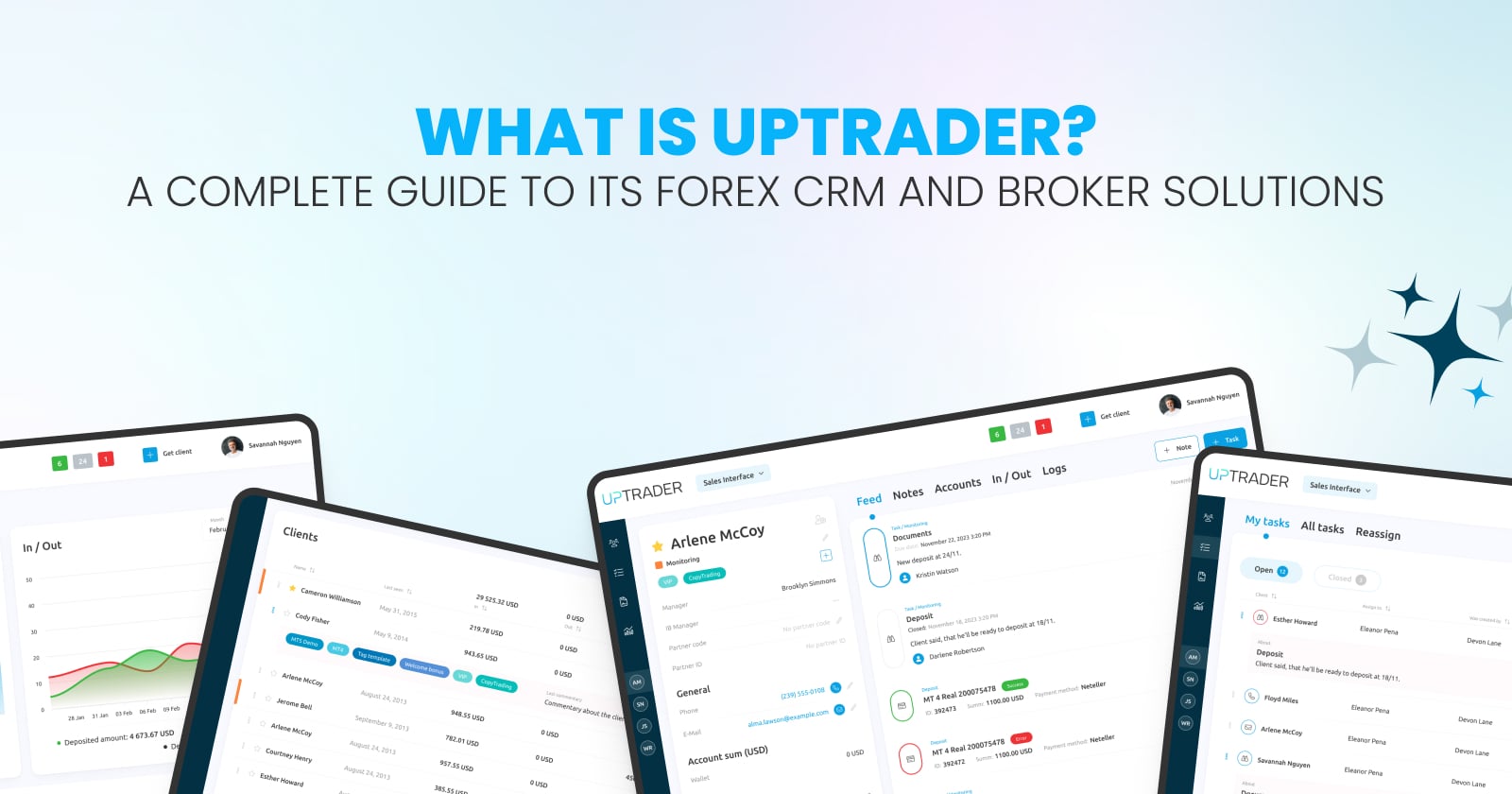
UpTrader consists of a triad of linked systems: The Trader's Room, Back Office, and Investment Module. Each one of these serves its own unique audience. However, they all share the same underlying data layer which allows for all three systems to automatically share data within themselves without any need for manual transfers or delays due to sync.
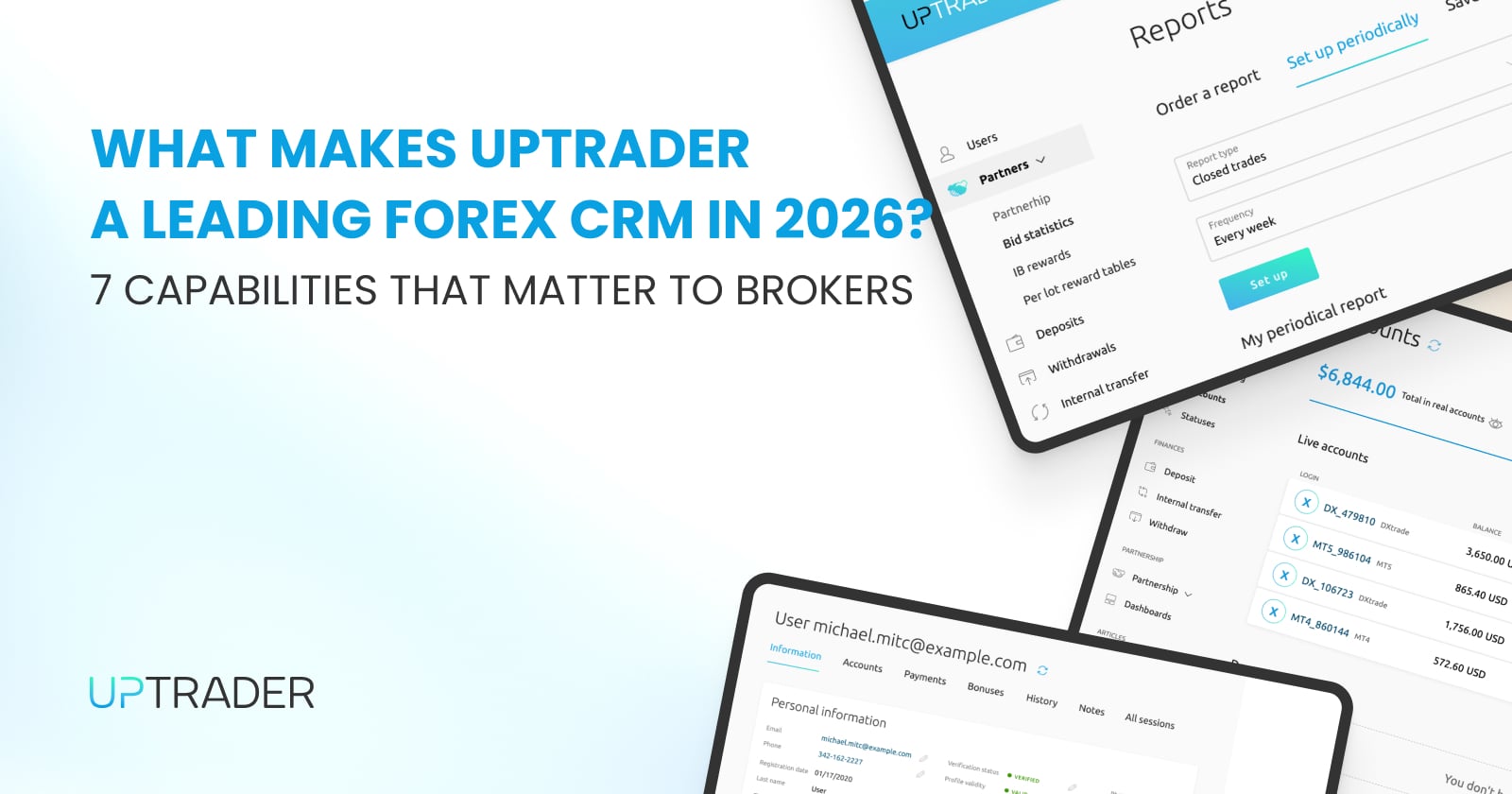
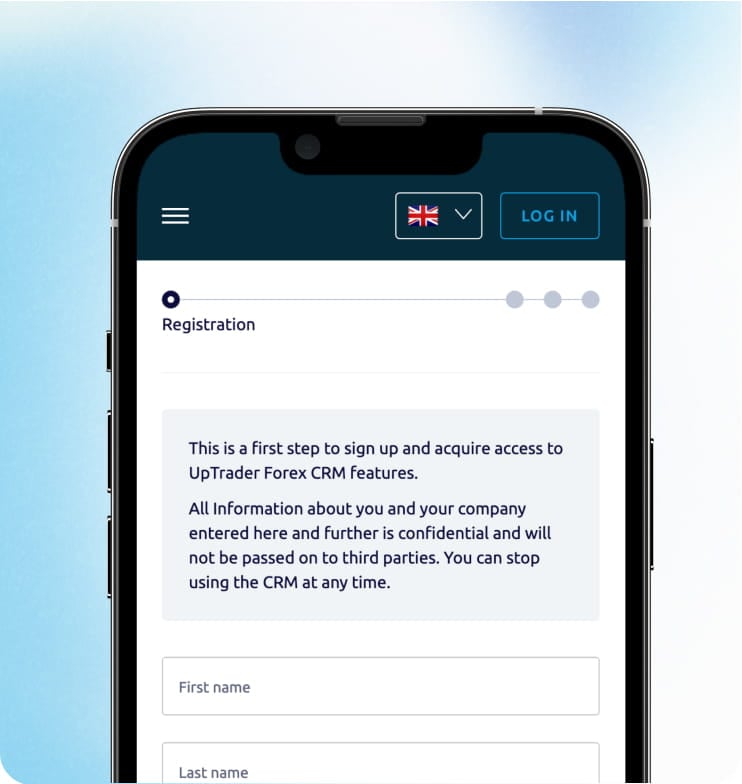
The Trader's Room serves as an interface between the client and UpTrader. This is where your client's traders will sign up, upload their KYC documents, manage their wallets, open and configure their trading accounts, start depositing and withdrawing funds into or out of their accounts, and initiate copy trading activities. The Trader's Room is also designed to be a self-service environment allowing the user to complete many of the basic transactional needs to their accounts without having to contact your support team. In addition, the interface is built to be fully mobile native providing the ability to complete all aspects of managing a trading account via mobile devices.
The Back Office acts as an internal command center for your operations teams. This is where your compliance group will manage automated KYC review queues, your finance group will process and reconcile any deposits and withdrawals to/from various PSPs, your partner management group will manage IB hierarchies and commission plans, and your executive management group will view operational dashboards. The Back Office is set up with role-based access controls so that each group will only see data and features that relate to their job function.
The Investment Module, branded as UpTrader Invest, is the managed accounts and social trading layer. It provides PAMM, MAM, and copy trading infrastructure within the same platform, allowing your brokerage to offer passive investment products alongside standard retail trading accounts. Strategy providers, follower management, allocation logic, and performance fee computation all operate within this module.
The critical design decision behind this architecture is that all three components share one data environment. A deposit processed through the Trader's Room is immediately visible in the Back Office ledger. A compliance decision made in the Back Office is instantly reflected in the client's portal status. An IB commission computed from trading activity in the Investment Module appears in the partner's dashboard without a separate calculation step. That shared data layer eliminates the reconciliation gaps and synchronization delays that plague brokerages running separate systems for each function.
Trading Platform Support
UpTrader integrates natively with Trading Platform 4/5, cTrader, and DXtrade. The integration is not limited to basic account provisioning. It includes real-time synchronization of account balances, open positions, margin levels, and trading activity data directly into the CRM and back office environment.
For your internal team, that means a client record in the CRM shows live trading data alongside communication history, deposit activity, compliance status, and IB attribution. Your sales and retention teams can see a trader's real-time balance and recent activity without switching to a separate admin panel. Automated workflows can trigger based on trading behavior thresholds, such as flagging a high-value account whose activity has dropped below a defined level.
The multi-platform support is relevant for brokerages that offer clients a choice of trading environment or that are expanding their platform offering over time. A brokerage that launches on Trading Plaftorm 5 and later adds cTrader does not need to replace its CRM or rebuild its integrations. The same back office, the same trader room, and the same compliance infrastructure support both platforms from a single instance.
Payment Infrastructure
UpTrader supports integration with hundreds of payment service providers, covering bank wire, credit card, e-wallet, and cryptocurrency deposit and withdrawal methods. The platform uses a unified wallet architecture where every fund movement is recorded as a discrete ledger event tied to a client identity and a transaction timeline.
For your finance team, this means deposits, withdrawals, internal transfers, refunds, and commission payouts all exist within a single traceable financial record. Month-end reconciliation takes place based on a single consistent ledger instead of disparate records across an assortment of PSPs and trading accounts. This also manages operational edge cases that drain the finance team’s capability for scale, such as updates on the status of declined deposits, chargebacks that require documentation and withdrawal approvals needing to go through compliance prior to processing.
The breadth of PSP support also applies to brokerages that operate in multiple locales; enabling a new local payment method for a specific market should be a configuration task not a custom development effort. As you expand to new geographies UpTrader’s pre-built PSP integrations are designed to reduce barriers to doing so.
IB and Partner Management
UpTrader’s IB module has a multi-tier partner hierarchy with configurable commission structures. Automated calculation of commissions occurs based on confirmed trade activities, hybrid models comprised of CPA and volume based rebates will be paid automatically without the need for manual calculation or reconciliation through spreadsheets.
Partners access a self-service dashboard through the Trader's Room where they can monitor their referral network, track client activity, view earned commissions in real time, and generate referral links. The data visible to partners matches what your internal team sees in the back office, which eliminates the discrepancies that create payout disputes and erode partner trust.
For brokerages where IB networks represent a primary acquisition channel, this is one of the modules where UpTrader's purpose-built architecture shows its advantage most clearly over generic CRM platforms. Multi-tier commission computation with real-time visibility is a workflow that generic tools were simply not designed to handle.
Compliance and KYC Workflows
UpTrader provides automated KYC and AML workflows that route document submissions through verification checks, auto-approve clean submissions, and flag discrepancies for manual review with the specific issue identified. The system supports jurisdiction-configurable compliance rules, allowing brokerages operating under multiple regulatory licenses to run different verification requirements from a single platform instance.
Every compliance decision generates an audit trail with timestamps and user attribution. Document submissions, verification outcomes, approval decisions, status changes, and overrides are all logged as discrete records. When a regulator asks you to demonstrate the compliance history of a specific client, the back office produces that trail directly rather than requiring manual reconstruction from disparate sources.
Prop Trading Support
UpTrader includes a dedicated prop trading module that handles challenge management, evaluation phases, funded account operations, and profit split calculations within the same platform that manages retail brokerage operations. Brokerages running hybrid models that include both traditional retail accounts and proprietary trading programs can manage both segments from a single back office without running parallel systems.
This capability reflects the convergence of prop trading and traditional brokerage that has accelerated over the past two years. A growing number of brokerages now operate both models simultaneously, and the infrastructure needs to support that operational breadth without fragmenting the client management, compliance, and financial workflows across separate tools.
Deployment and Time to Market
UpTrader is positioned as a platform that can move from initial setup to live operations quickly. The vendor states that basic deployments can be configured and operational in under 24 hours, though more complex implementations with multi-jurisdiction compliance and extensive PSP integrations will take longer. The pre-built nature of the platform means you are configuring an existing system rather than building integrations from scratch, which avoids the months-long implementation timelines common with modular stacks.
Who UpTrader Is Built For
UpTrader is designed for forex brokerages, white-label operators, and prop trading firms that need a unified operational platform rather than a collection of disconnected tools. It is particularly well-matched for brokerages in growth phases where increasing complexity across jurisdictions, IB networks, and client volume makes the limitations of generic tools increasingly visible. It is equally suited for new brokerages that want to launch with infrastructure they will not need to replace within 12 months.
Conclusion
UpTrader is a purpose-built forex brokerage operations platform that combines CRM, back office, trader room, payment processing, compliance automation, IB management, and social trading infrastructure into a unified system. Its architecture is designed around the principle that these functions share data dependencies that make separation inefficient, and that a brokerage operates best when every department works from the same operational layer.
Whether it is the right choice for your brokerage depends on whether its unified model matches your operating approach and whether its trading platform support, PSP coverage, and compliance configurability align with your specific requirements. The most effective way to evaluate that fit is to map your own operational workflows first and then test whether the platform handles them natively.
Request a tailored demo and see how UpTrader maps to your brokerage here.