





Forex Broker Software: The Essential Tools Powering Brokerages in 2026
Share this publication:
Over the years, the challenges brokering Forex have changed in many ways. Competition is sharper, traders are more informed, regulators expect transparency, and operational mistakes are far more expensive. In this environment, your success depends less on bold promises and more on the software infrastructure you put behind your brand. Forex broker software is no longer a single system. Since 2022, it has become a fully automated, integrated, risk-managed ecosystem for data, compliance, and client management for balance sheets. This allows you to focus your attention on growth.
If you want your brokerage to remain relevant in 2026, you need to understand which tools matter, how they work together, and why cutting corners is no longer an option.
What Forex broker software really means in 2026
Forex broker software refers to the full technology stack that supports your brokerage’s daily operations. It goes far beyond a trading platform. In 2026, broker software covers everything from lead acquisition to post-trade reporting, all working as one system.
You rely on it to:
- Securely and efficiently onboard clients.
- Manage and Control accounts, permissions, and risk.
- Process deposits and withdrawals without error.
- Assist and Support clients without delays.
- Retain and safeguard regulatory and operational control.
When this stack works smoothly, it creates a flawless, reliable brokerage. When it doesn’t, even strong marketing won’t save you.
Why modern brokerages can’t afford outdated systems
Many brokerages fail not because of market conditions, but because their systems don’t scale with their ambitions. Limited visibility and manual functions, tools that are not aligned, are bottlenecks which move sluggishly and creates a backlog that worsens with the passage of time.
With obsolete software, you may experience:
In 2026, a loss of leads due to sluggish onsite functions, and a loss of leads due to sluggish onsite functions. High operational risk, Increasing costs to support the systems, Resource draining compliance, Incomplete data that leads to poor strategic choices.
Modern software for brokers removes these design friction points, and adds value. It gives you clarity where there was guesswork and structure where there was chaos.
The core tools every Forex brokerage needs
A successful brokerage in 2026 is built on several essential software components. Their true strength lies in how they complement each other, despite having individual purposes.
Trading platform integration
Your trading platform is client-facing, but as a broker, it is a data capture tool. Broker software integrations with trading platforms should capture:
- Account balances and equity
- Open and closed positions
- Exposure and margin risk
- Trading patterns
When this data is available in your internal systems, your teams will be able to act more quickly and with better precision.
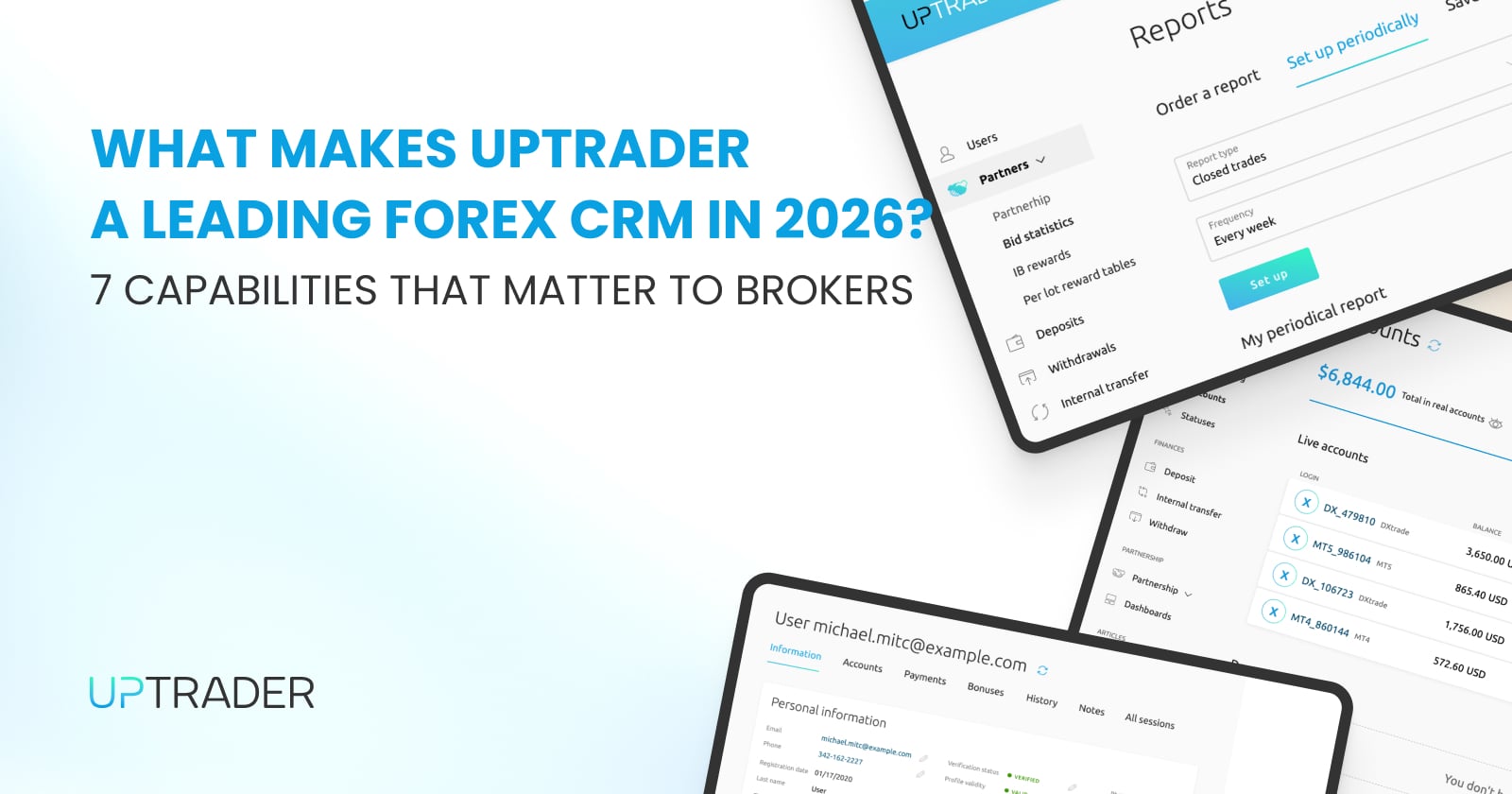
Forex CRM Software built for trading businesses
Generic CRMs from 2026 will be ill-suited for brokerages. In that year, you’ll want a trading behavior CRM, not a contact details CRM.
A well-built Forex CRM offers:
- Visibility into the complete client lifecycle from acquisition to active trader status
- Client segmentation by trading activity and deposit level
- Unified coordination of sales, support, and retention teams
- Context-aware automation of repetitive tasks
This ensures internal alignment of teams and external engagement of clients.
Forex Back-office and operational control systems
Solid operational backbone is the mark of a truly robust brokerage. Control is what back-office software is meant to offer.
You use it to:
- Administer account permissions and status
- Control financial activities
- Monitor actions and approvals from your team
- Maintain comprehensive audit trails
In 2026, this level of control is expected, not optional. It protects both your clients and your business.
Payment and financial processing tools
Fast, transparent payments are a competitive advantage. Slow or unclear transactions damage trust instantly.
Broker software must support:
- Multiple payment methods and regions
- Automated transaction tracking
- Clear approval workflows
- Accurate financial reporting
When payments are tightly integrated into your system, disputes decrease and operational efficiency improves.
Risk management and monitoring tools
Risk can come not just from the market, but also from behavior, systems, and human error.
Modern broker software can help you monitor:
- Unusual trading activity
- Margins and exposure
- Automated alerts, and thresholds
- Issues before they get out of hand
This proactive approach can reduce potential losses and help build overall stability.
Compliance and reporting systems
Regulations are constantly changing and by 2026, they expect structure, not explanations. Without manually doing things, your software should make compliance a part of your daily operational routine by:
- Securely storing your documents and verification data
- Keeping a record of every action, internal and client-facing
- Automatically generating reports
- Controlling data access by roles and responsibilities
When compliance is a part of your systems, it is no longer a distraction, because it is a part of your operational routine.
How integration defines efficiency
Struggling brokerages and efficient ones are vastly different when it comes to integration.
When systems work in silos, broker teams work harder, and the results are inferior. With integrated broker software, you can:
- Instantly share data across different departments
- Reduce redundant tasks
- Consistent record keeping of clients
Make informed decisions In 2026, integration should not be viewed in technical or innovative ways, but rather operationally.
Scalability as a design principle
Growth should not break your systems. Yet many brokerages experience exactly that.
Forex broker software of today can scale by:
- Supporting higher volume without performance loss
- Automating processes when demand increases
- Measurable control through all growth phases
- Cost-effective modular expansion over expensive full replacements
It increases operational peace of mind and lets you grow how you want.
What to look for when choosing Forex broker software
On choosing broker software, look past the marketing buzz and hype and think of the real effect.
- Does this software reflect real brokerage workflows?
- Can it adapt as regulations or markets change?
- How transparent are permissions, logs, and reporting?
- Will it support growth without major restructuring?
It should feel seamless as an extension of your business.
Common mistakes that limit Forex broker success
Even in 2026, some mistakes remain surprisingly common:
- Using disjointed tools
- Selecting software purely on cost
- Oversight of internal user experience
- Implementation and training being an afterthought
- Upgrading infrastructure last too long
These all create latent costs that only show in the future. The impact of software on client trust Clients can’t see your inner systems, but they can feel the impact of them.
The role of Forex software in client trust
Clients may never see your internal systems, but they feel their impact.
Fast onboarding, accurate balances, smooth withdrawals, and consistent support all depend on software working quietly in the background. When systems fail, trust erodes quickly. When they work, your brokerage feels dependable.
In a crowded market, that reliability is often what keeps clients with you.
Looking ahead: Forex broker software as a competitive advantage
By 2026, Forex broker software will be more than just basic infrastructure.
The brokerages that succeed will be the ones that view tech as a foundational component rather than an afterthought. These brokerages will invest early, integrate on a deep level, and operate with clarity as opposed to complexity.
If you want to operate on that level, your software and tools must be built for the current brokerage operational reality, not the outdated brokerage operational reality.
Final thoughts
Every decision your Forex broker software makes is invisible and unaccounted for. The right software will always provide you with stability, efficiency, and plenty of growth. 2026 will be the year of brokerages that truly understand their software. If your software supports your strategy, instead of limiting it, you're already ahead of the curve.
You can implement a robust Forex CRM solution like UpTrader to help automate tasks and bring attention to more important tasks. Talk to a consultant on our site today to get a personalized demo.