


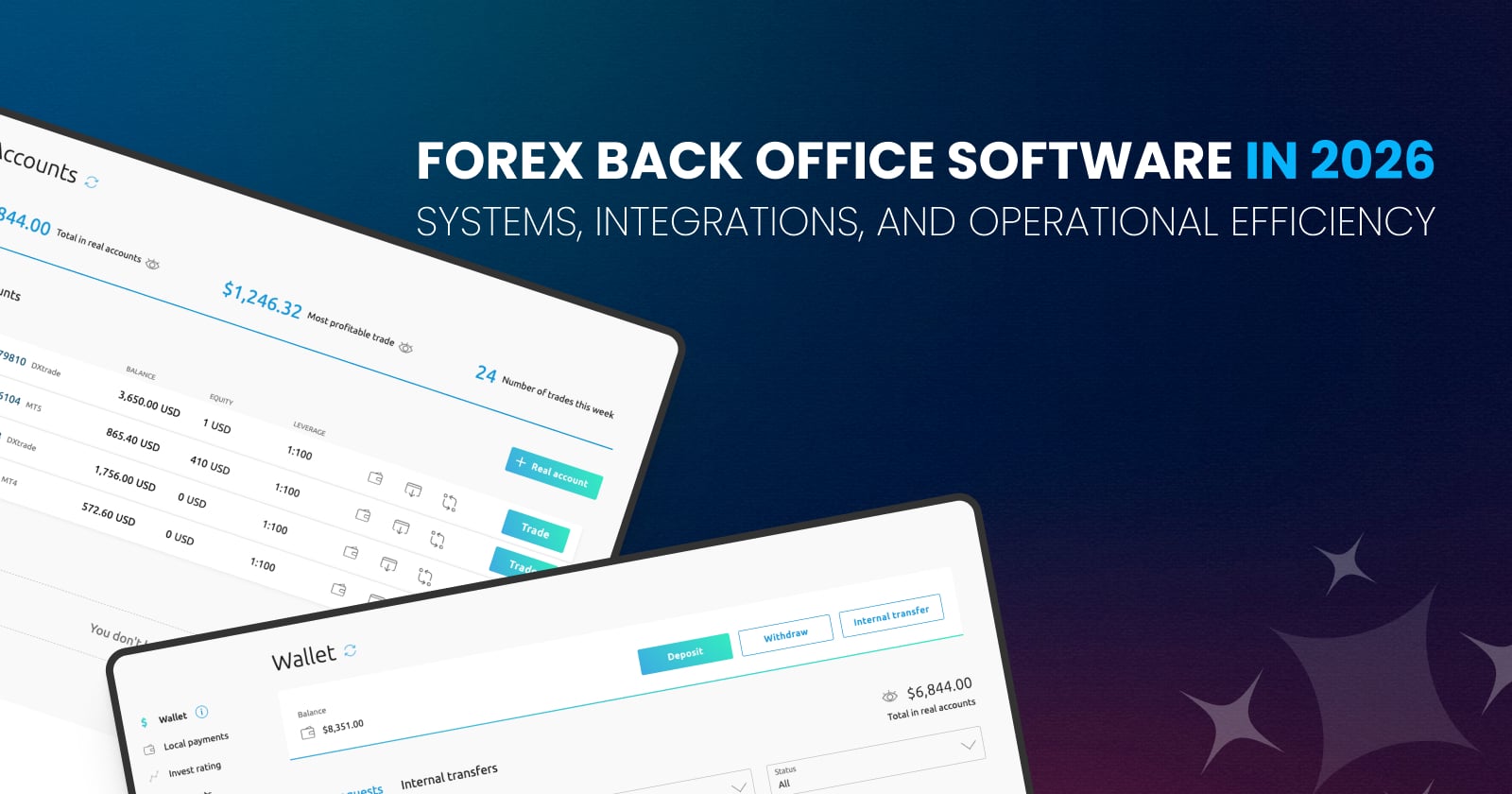
Forex Back Office Software in 2026: Systems, Integrations, and Operational Efficiency
Share this publication:
When you run a Forex brokerage in 2026, there are many more moving parts to manage than ever before. There is increasing regulatory pressure in all major jurisdictions; client expectations are rising dramatically; and the number of daily operational tasks (onboarding, compliance checks, payment reconciliation, IB commission management) has ballooned to the point where you cannot manually process everything. If you are still piecing together spreadsheets and other disconnected tools to operate your back office, you are working harder than you need to work. You are actively losing time, clients, and competitive ground. And this is where forex back office software becomes the operational backbone of your entire brokerage. Not a convenience feature, but the infrastructure everything else runs on.
What Your Forex Back Office Software Is Actually Doing
Before you evaluate any platform, it helps to map the real workflows your team runs daily. Most brokers think of the back office as an admin function. It is not. It is an operational engine that touches every client-facing outcome your brokerage produces.
On any given trading day, your back office is processing new account applications, verifying identity documents, reviewing compliance flags, approving or rejecting deposits, reconciling withdrawal requests, calculating IB commissions, generating regulatory reports, and handling client support escalations that require account-level access. That is not paperwork. That is your business running in real time.
When that engine is slow, fragmented, or reliant on manual input, errors multiply fast. A withdrawal that should clear in two hours takes two days. An IB commission miscalculation damages a key partnership. A KYC file sits in a queue long enough that a prospective client moves on to a competitor. These are not edge cases. They are the daily cost of under-built back office infrastructure.
KYC and Compliance: Where Most Brokers Lose the Most Time
If you ask any operations manager at a mid-size brokerage where they spend the most unproductive hours, the answer is almost always KYC. Document collection, identity verification, sanctions screening, PEP checks, and ongoing monitoring are legally non-negotiable across all major regulators including the FCA, CySEC, ASIC, and DFSA. But doing them manually at scale is operationally unsustainable.
Modern Forex back office software handles all of this by automating your entire compliance pipeline. New Forex broker solutions have redefined KYC as an automated / structured process, instead of being a manual process to check-off. The moment a new client submits an application, your system will automatically send out requests for documents, run an automatic ID verification through your integrated providers, verify against global sanction lists in real-time (without any staff member touching the file) and will flag any anomalies for your staff to review before making an informed decision.
Providers like Sumsub report that automated KYC workflows can reduce manual task time by up to 90% and increase onboarding conversions by up to 35%. Platforms like Syntellicore can complete automated KYC and AML verifications including facial recognition and document checks within 30 to 60 seconds. That speed advantage translates directly into conversion rates. The faster a verified, funded client reaches the trading platform, the less likely they are to abandon the process mid-way.
A 2023 Thomson Reuters survey found that 41% of clients have left a financial institution or abandoned an application specifically because of the difficulty and length of the KYC onboarding process. That statistic should inform exactly how much weight you give to compliance workflow speed when selecting your back office platform.
Deposit and Withdrawal Processing: The Workflow That Defines Client Trust
Nothing damages client trust faster than a delayed withdrawal. And nothing creates more internal operational chaos than a deposit processing workflow that requires manual intervention at every stage.
Your back office software needs to handle the full payment lifecycle: receiving deposit notifications from PSPs, reconciling against trading account balances, crediting accounts without delay, processing withdrawal requests against available margin, routing payments through the correct PSP based on geography or currency, and generating settlement records for accounting. Leading platforms like FXBO provide access to over 340 PSPs worldwide, which means your payment routing options at the back office level are no longer a bottleneck for geographic expansion.
When a client requests a withdrawal, a properly configured back office system checks account status, verifies KYC clearance, applies any applicable holding periods, and routes the payment automatically. Your operations team only intervenes when an exception condition is triggered. This is how you process hundreds of withdrawal requests on a volatile trading day without adding headcount or introducing processing errors.
Client Management: One Record, Full Visibility
Your forex back office software is not a CRM in the traditional sense, but it needs to function like one for your operations team. Every client record in your system should deliver a complete operational picture: account status, verification tier, deposit and withdrawal history, open positions summary, compliance flags, support history, and IB association.
When your support team or compliance officer pulls up a client file, they should not be switching between three platforms to assemble that picture. Forex back office software integrates all customer profiles and trading accounts including balances and trade history, eliminating information disparity across sales, operations, finance, and compliance departments.
The back office platforms doing this well centralize client data as a single source of truth that every internal function reads from and writes to. A compliance flag added during a routine review is immediately visible to the finance team processing a withdrawal. An account status change made by operations is reflected in the client portal in real time. These are not optional extras. They are the workflow fundamentals that determine whether your team operates as a cohesive unit or in disconnected silos.
IB and Affiliate Tracking: Where Revenue Partnerships Are Won or Lost
If your brokerage runs an introducing broker or affiliate program, your back office is responsible for the accuracy of every commission calculation, every payout, and every performance report your partners receive. Essential back office capabilities for IB management include multi-tier commissions, automated rebates, and dedicated partner portals.
IB tracking in a well-built back office system works like this: every referred client is tagged to their introducing broker at account creation. Every trade that client executes generates a commission entry based on the IB's pre-configured tier structure. At the end of the commission period, the system aggregates those entries, applies any volume thresholds or tiered rates, generates a commission statement, and queues the payout for processing through your payment workflow.
Commission disputes with IBs are costly, both financially and relationally. When your system produces auditable, real-time commission reports that your IBs can verify independently through a partner portal, you eliminate most disputes before they start. One prop firm that integrated automated compliance and partner management into its operations reduced manual compliance work by 60% while onboarding over 200 traders without adding staff. The same principle applies to IB operations at scale.
Reporting: Where Operational Data Becomes Business Intelligence
The reporting function of your forex back office software is where operational data becomes actionable intelligence. You need more than transaction logs. You need reports that identify where your operational bottlenecks are, which client segments are churning fastest, which IBs are underperforming, and where your payment processing is introducing friction.
Regulators also expect structured reporting. Depending on your jurisdiction, you may need to produce transaction records, suspicious activity reports, client asset segregation statements, and full audit trails on demand. If your back office cannot generate those reports cleanly from its own data, your exposure during regulatory examinations is significant. Platforms like CurrentDesk provide access to more than 25 advanced report types, including end-of-day summaries, rebate and bonus reports, account statements, compliance monitoring, and detailed sales and marketing analytics.
The brokers with the most operationally efficient back offices in 2026 treat reporting as a live management tool, not a compliance checkbox. They monitor daily metrics on onboarding conversion, deposit-to-trade time, withdrawal clearance rates, and IB performance, and they make real operational decisions from that data.
Integration Architecture: The Make-or-Break Factor
The best forex back office software in 2026 is not the one with the longest feature list. A reliable back office system must integrate smoothly with trading platforms, liquidity hubs, payment gateways, and digital wallets, synchronizing balances, trading activity, and payment statuses so brokers can manage all platform aspects without juggling multiple applications.
Your trading platform, whether Trading Platform 4/5, cTrader, or a proprietary solution, needs to sync positions, account status, and margin data in real time. Your PSPs need bidirectional payment confirmation. Your KYC providers need automated handoffs. Enterprise-tier platforms like B2Core offer built-in liquidity bridge and aggregation for direct access to over 800 providers within the back office dashboard, which reflects how deeply integrated the top-tier systems have become.
When those integrations are native and well-maintained, your back office runs as a unified system. When they are brittle, manual, or dependent on third-party middleware that struggles during high-volume periods, your operations team becomes the integration layer. That is precisely the kind of inefficiency that compounds into serious operational risk when markets move fast and volume spikes.
Conclusion and Final Thoughts
Your back office is not the part of your brokerage that clients see. But it is the part that determines whether their experience is smooth or frustrating, whether your team is productive or overwhelmed, and whether your operations can scale without proportionally scaling headcount.
In 2026, brokers that move from reactive to proactive operations through modern back office infrastructure are the ones positioned for systematic growth rather than constant firefighting. The brokers pulling ahead are not necessarily the ones with the most traders or the tightest spreads alone. They are the ones who have built a back office system that handles compliance, payments, partner management, and client data quietly, accurately, and fast, so the front of the house never has to carry the weight of what is breaking behind the scenes.
Want a properly setup back office software that does everything for you. Request a demo for UpTrader’s back office solution today so you know what you are getting into before committing.