



Happy Holidays

Share this publication:

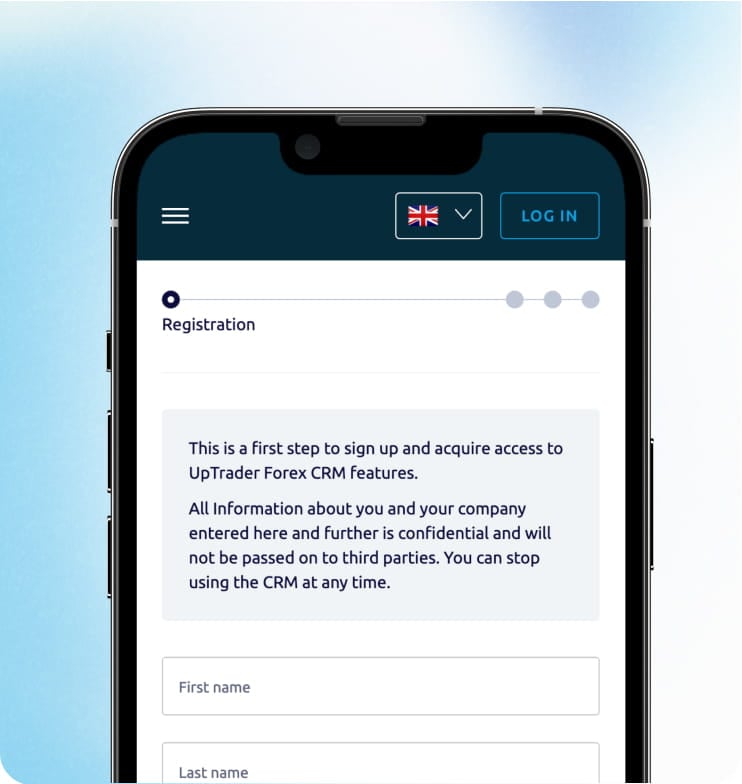
Not a demo — a real CRM instance, created automatically right after registration. No setup fees.

Share this publication:
Share this publication:
When starting a Forex brokerage, something that is often overlooked is that start-up CRM system implementation can sometimes take a lot longer than expected. Other matters like obtaining licenses, raising funds, or establishing partnerships can go pretty smoothly but, for some reason, Forex CRM system setup can prove to be a rigorous task requiring a great amount of time and money. Initially, it might take weeks or even months to finalize several stages of implementation of your Forex CRM system. As a result, you become operational only on paper while your competition is busy acquiring clients.
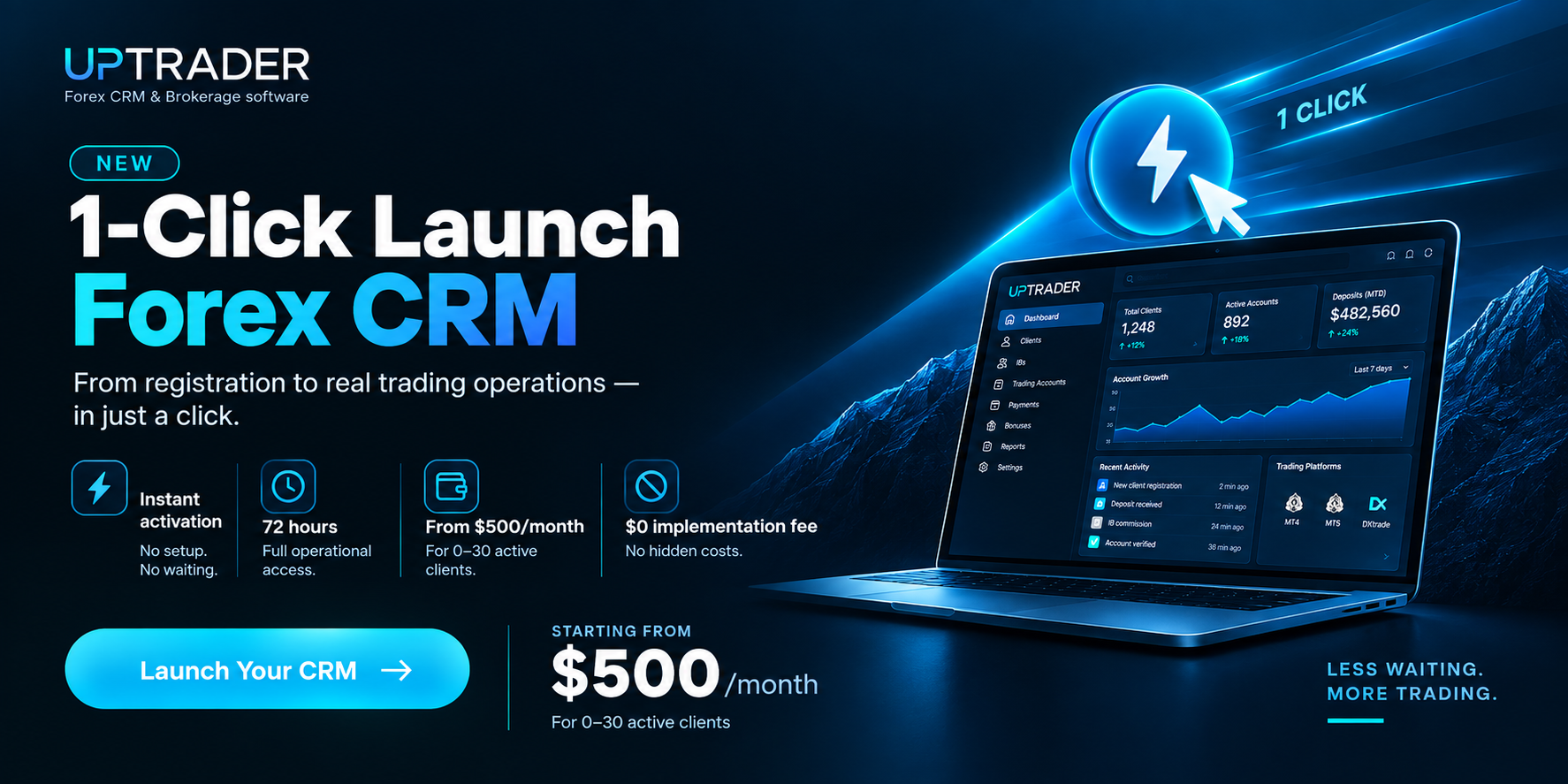
At UpTrader, they thought of overcoming this issue by developing the unique Forex CRM solution called 1-Click Launch.
You will only need to pay 500 dollars per month with no setup costs (for 0-30 traders). You can start using your Forex CRM immediately after registration! In the first 72 hours, you will get to know how the product works without spending a penny.
Brokers can be justified in thinking twice about what cheap pricing entails. After all, low pricing generally means most of the essential features and tools are locked behind pay walls. Thus, it is possible to start using a new product thinking it covers all the bases only to be forced to buy an add-on to have access to such important features like a partner management system or trading tools.
The UpTrader’s approach, however, is more effective in this regard. The base package contains absolutely all the essential features that are necessary for brokers to operate.
The clients access their Trader’s Room where they can manage their money as well as check the settings and statistics of their accounts. Every department in a brokerage touches this daily.
Our interest in the IB Partnership System was piqued by the fact that other vendors charge additional fees for multi-tier partner management and automatic commission calculating at this level. In contrast, UpTrader provides these features for free, as part of its standard package, granting access to partners’ self-service dashboards along the way.
This is also true for the Bonus Module designed for promotions and the Prop Trading Module designed to assess funded accounts and trader progression – they are offered with no upselling. Last but not least, the standard package includes the Sales Module for lead tracking and pipeline automation.
This level corresponds to early-stage brokerages, as it includes 30 clients’ activity per month. Learn more at Uptrader Forex CRM 1-Click Launch.
Consider the conventional process of Forex CRM implementation. Once the contract is signed, the project manager is assigned, and Discovery and Configuration phases are completed, the process moves to testing of the payments system, branding, and training. This whole process may take from two to eight weeks before the company is able to start operating.
Why does it matter? In all these weeks, the marketing budget is generating leads that have nowhere to go. Meanwhile, IB partners are sitting idle, and the company is paying rent for the systems it cannot use.
However, with UpTrader, all this can be avoided. The system is activated instantly after the registration. The system is already built according to the needs of a brokerage and accepts all necessary platforms from the very beginning.
A new brokerage can use the UpTrader Forex CRM immediately after signing the agreement with the payment system while an existing one can run UpTrader's systems together with the system it has.
What this means in practice depends on where you are.
A startup brokerage can have its Forex CRM running before PSP approvals even come through. A brokerage migrating from a different provider can run UpTrader in parallel and compare before committing. A prop firm launching its first challenge program can be live within hours of registration, not weeks.
The ordinary vendor demonstration can be described as a regulated activity. While a seller shows you a customized product with a certain dataset, it works perfectly as it has been made to work like this. As a result, you understand the nature of the product. However, you have no idea if it will fit your company.
The 72-hour free trial offered by UpTrader is an entirely new story. You are given full access to an operational Forex CRM system. You can create onboarding flows, implement your IB commission model, try out your deposits and withdrawals, and set up your prop trading tasks. You can run the back office as your team would typically do, as per your configuration rules and not according to a step by step instruction.
In case the system suits you, you switch to a paid membership. You will carry your previous configuration to the new system. Should it not fulfill your needs, you can find this out in three days instead of three months and thousands of dollars.
This information will be useful in case you were planning to open a forex brokerage without taking a long pause between applying for a license and beginning to work. The same can be said for the CFD brokers looking to develop their infrastructure or use evaluation programs for the propriety trading businesses launching for the first time or introducing the transition from an IB to the brokerage holding its own license.
The brokers already working on a Forex CRM that is not suitable anymore will find out that the evaluation will allow testing the new one in practice before the migration.
Enterprise brokers that are very custom-oriented concerning the workflows and compliance setups can start working with UpTrader using the One-click launch option.
Most forex CRM providers quote entry-level prices that range between $1,000 and $1,500 per month. On top of these costs, setup fees of $1,000 to $5,000 are fairly commonplace. Mid-size systems usually cost EUR3,000 to EUR10,000 a month, and large-scale installations typically cost more than EUR25,000 a month.
UpTrader provides this service for $500 a month with no setup fees and instant activation together with a free evaluation period of 72 hours.
This model works thanks to the fact that the implementation process is standardized. Thus, the cost of the system is decreased due to the elimination of the manual process used by other vendors. The system itself is not altered in any way.
If there are similarities in your current pricing conditions with those offered by UpTrader, the company will explain how its platform matches up with your own business.
Register for instant access and start your 72-hour evaluation here

UpTrader will be at Forex Expo Dubai 2026 on September 22-23 at the Dubai World Trade Centre. Founder Stanislav Vaneev and CEO Vasily Alexeev will both be present at the event, available for direct conversations with brokers, IBs, prop trading operators, and technology partners exploring CRM and brokerage infrastructure for their operations.
Forex Expo Dubai is the largest forex industry event in the Middle East. The 2026 Dubai World Trade Centre event involves five halls and gathers more than 250 exhibiting firms and around 100 speakers, as well as countless visitors from the international trade community. The event draws forex brokers, fintech companies, liquidity providers, payment processors, and trading technology firms, making it one of the most concentrated networking environments in the industry calendar.
For UpTrader, the timing is deliberate. The company has spent the past several months rolling out a significant series of platform updates, and Forex Expo Dubai puts those updates in front of the audience that stands to benefit from them most.
UpTrader's Forex CRM has evolved substantially through 2026. Rather than arriving at the expo with a pitch deck and a promise, the team is coming with a platform that has already shipped the capabilities most brokerages are still waiting on from their current providers.
The platform updates span several operational layers that matter to growing brokerages. A completely redesigned dashboard module built on a unified data aggregation engine delivers faster loading and flexible date-range queries across client, back office, and global broker views. Enhanced security logging now tracks security code regeneration, administrator actions, and role-based permission changes with full audit trail coverage. The payment layer has expanded to include BEP-20 USDT via CryptAPI, Cryptonow v2 multichain support, APS XPaid integration, and expanded currency coverage through HeroPayments. And a tag-driven automation system now connects client segmentation to payment method visibility, PSP routing, and prop trading challenge access without manual configuration.
These are not roadmap items. They are shipped, live, and running inside brokerage environments right now. That distinction matters at an event where attendees are evaluating infrastructure they need to deploy in Q4, not features they might receive next year.
Industry events compress into two days what normally takes weeks of vendor outreach to accomplish. The conversations that happen at Forex Expo Dubai between brokers, technology providers, and payment companies shape infrastructure decisions for the quarter ahead. For brokerages evaluating Forex CRM platforms, meeting the founding team and senior leadership directly provides a level of transparency that no demo call or sales presentation can replicate.
Stanislav Vaneev and Vasily Alexeev being personally present signals something about how UpTrader approaches the market. Forex CRM vendors frequently send sales teams to expos. Having the founder and the CEO available for direct technical and strategic conversations gives prospective clients access to the people who set the product direction, not just the people who present it.
For brokers attending Forex Expo Dubai who are currently dealing with Forex CRM limitations, whether that means manual IB commission calculations, fragmented payment operations, compliance gaps, slow onboarding, or a platform that cannot support copy trading and prop trading from a single back office, the event offers an opportunity to evaluate UpTrader's approach firsthand.
The conversations that produce the most value at industry events are the ones with a specific operational context behind them. If you are attending Forex Expo Dubai and any of the following applies, a conversation with the UpTrader team is worth your time.
You are a startup brokerage preparing to launch and need Forex CRM infrastructure that is operational from day one without a multi-month implementation cycle. You are an established broker whose current Forex CRM cannot support multi-brand operations, multi-platform integration, or automated IB management at your current scale. You are running a prop trading firm that needs challenge management, evaluation workflows, and funded account operations inside the same system that handles your retail brokerage clients. You are an IB or affiliate network operator looking for a partner portal with real-time commission visibility and multi-tier hierarchy support. Or you are a fintech operator entering the brokerage space and need to understand what a purpose-built forex CRM actually looks like compared to the generic alternatives.
Stanislav Vaneev and Vasily Alexeev will be available throughout both days of the event. Reach out to the UpTrader team in advance to schedule a dedicated conversation, or connect directly at the expo
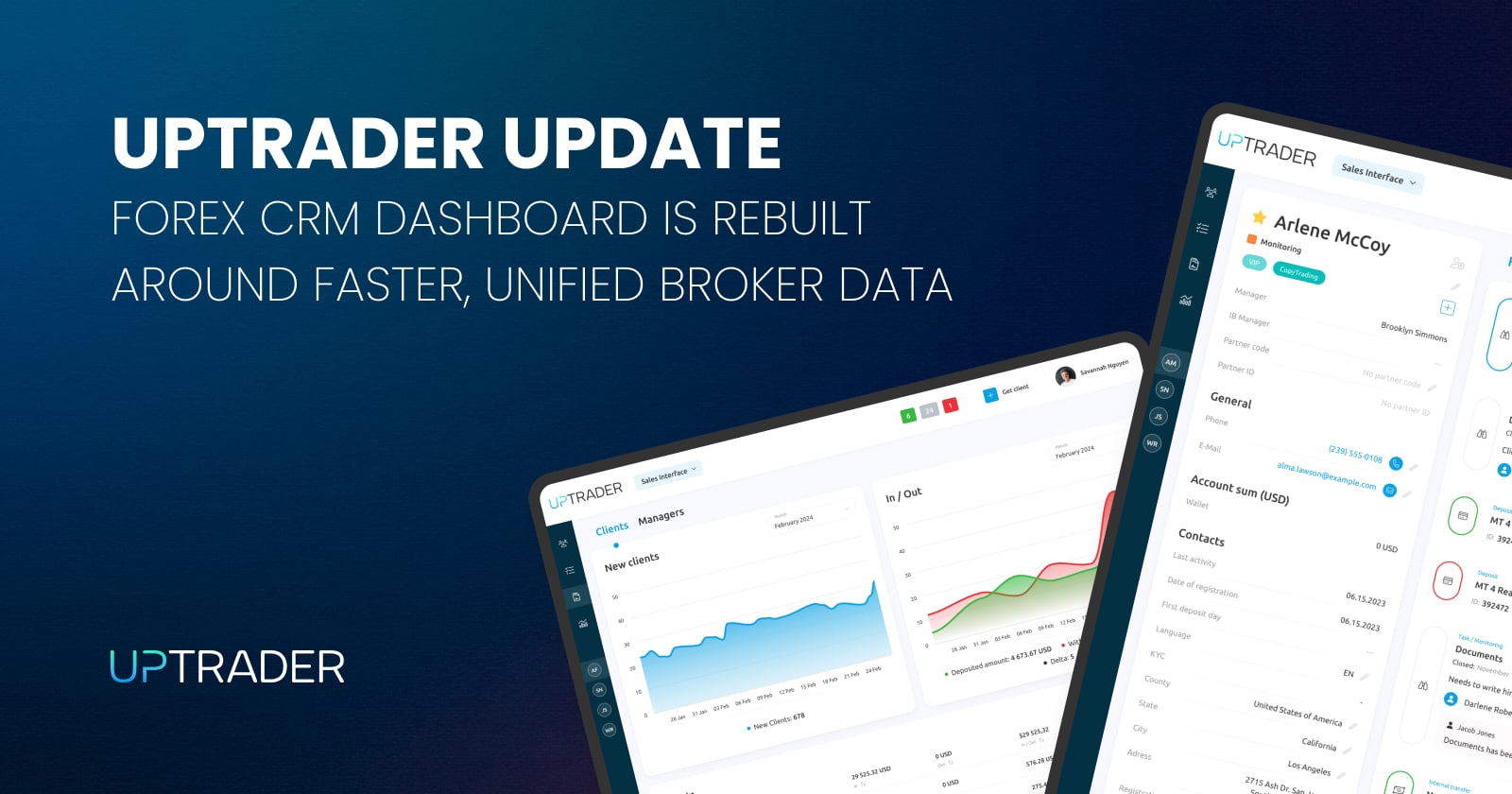
A dashboard is not a report with better colors. That sounds obvious, but look at how most forex CRM vendors treat dashboards and the distinction starts to blur. They give you a screen with charts. Those charts pull from whatever data the system happens to have cached. The numbers update when someone refreshes the page or when a scheduled job runs. And the moment you need to see deposits alongside client growth alongside IB performance alongside trading activity for a specific date range, you are back to exporting spreadsheets and stitching the picture together manually.
For a long time, that was acceptable. Dashboards were a visual convenience layer. The real work happened in spreadsheets, in admin panels, in PSP portals, in trading platform managers. The dashboard was nice to glance at. Nobody actually ran their brokerage from it.
That era is over. In 2026, the brokerages that move fastest are the ones whose leadership, operations, and sales teams can see what is happening across the entire business in real time, from a single screen, without waiting for someone to compile anything. Dashboard architecture has stopped being a UI decision and become a competitive advantage.
Here is what daily operations look like inside a brokerage where the dashboard layer was not built to unify data.
Your head of sales wants to know how many new clients registered this week and how many have deposited. That data lives in the CRM, but the deposit totals need to be cross-referenced with the payment module. Your compliance manager wants to see KYC approval turnaround times alongside client onboarding volume. That requires pulling from two different system views. Your finance team needs deposit and withdrawal totals by PSP for the month. They export a report, open a spreadsheet, and start filtering. Your IB manager wants to see which partners are generating the most funded accounts, not just registrations. That means combining partner attribution data with deposit records and trading account activation, which sit in three different areas of the back office.
None of these requests are unusual. They are the standard questions that brokerage leadership asks every day. And in most forex CRM environments, answering them requires navigating multiple screens, running separate queries, or asking someone to manually compile the numbers. By the time the picture is assembled, it is already hours old.
The operational cost is not just time. Delayed visibility means delayed decisions. A deposit volume drop that should trigger an investigation on Monday does not surface until Wednesday's report. A top-performing IB whose referral quality is declining does not get flagged until the monthly review. A spike in withdrawal requests that might indicate a client satisfaction issue gets noticed after the damage is done, not while it is still developing.
Most dashboard redesigns focus on the visual layer. Better charts. Cleaner layouts. More widgets. That is cosmetic. The problem that actually needs solving sits underneath the interface, in how the dashboard pulls, combines, and serves data from across the brokerage operation.
A unified data aggregation engine is the architectural layer that collects data from every operational source, the forex CRM, the back office, the payment layer, the trading platform integration, the IB module, normalizes it, and makes it queryable from a single point. Instead of each dashboard widget running its own database call against its own data silo, every widget draws from the same aggregated dataset. That is what makes cross-functional views possible without manual assembly.
Speed matters here, and not in the abstract "performance optimization" sense. When a dashboard takes 8 to 12 seconds to load because it is running separate queries against separate tables for each section, your team stops using it. They revert to spreadsheets. They build their own tracking systems. The dashboard becomes a decoration. A fast aggregation engine that serves pre-unified data means sub-second loading, which means the dashboard becomes the first place your team looks, not the last.
Flexible date-range querying is the other capability that determines whether a dashboard is genuinely operational. "How did we perform last week" is a different question than "what happened on Tuesday" or "show me Q2 versus Q1." If the dashboard only shows a fixed time window, current day or current month, every historical comparison requires an export. Date flexibility turns a monitoring tool into an analytical one.
UpTrader recently completed a full redesign of its Dashboard Module, and the meaningful change is not the visual refresh. It is the unified data aggregation engine underneath it.
The new architecture pulls deposits, withdrawals, trading activity, client growth, partner performance, and account activity into a single aggregated layer. Every dashboard view, whether accessed by a client in the trader room, by an individual back office user, or by a brokerage owner looking at global operations, draws from the same unified dataset.
That structural decision enables three tiers of dashboard access that were not previously possible without manual data assembly.
Client Interface dashboards give traders a clear view of their own account activity, deposit and withdrawal history, and trading performance. The data is personal, scoped to the individual client, and rendered from the same engine that powers the internal views. Consistency between what the client sees and what your team sees eliminates the support tickets that arise when numbers do not match across interfaces.
Back office per-user dashboards give each internal team member a view tailored to their role. A compliance officer sees KYC queue depth and approval rates. An employee in the finance department has access to payment volumes, and reconciliation status, whereas a sales representative is able to view lead conversion as well as client activities. While each user is allowed to access certain information based on their role in the organization, the system still maintains one database instead of separate databases used by different departments. A sales agent who needs to check whether a lead has deposited does not need to switch to the finance module. The dashboard already includes that data point within their permitted view.
Global broker dashboards give leadership a cross-functional view of the entire operation. Deposits, withdrawals, new registrations, funded accounts, trading volume, IB performance, and operational trends, all visible in a single interface with flexible date-range filtering. Daily views show what is happening right now. Summary views show how the numbers trend over weeks and months. Both draw from the same aggregation engine, so the daily number and the monthly total are always consistent.
Faster loading across all three tiers is a direct result of the unified engine. Instead of each widget querying independently, the dashboard serves pre-aggregated data. The difference between a dashboard that loads in under a second and one that takes ten seconds is the difference between a tool your team uses reflexively and one they avoid.
Nobody markets dashboard architecture as a competitive differentiator. Vendors talk about integrations, compliance automation, IB management. Dashboards get a bullet point and a screenshot.
But consider what a brokerage with genuine real-time operational visibility can do that a brokerage running on spreadsheets and delayed reports cannot. They spot deposit volume drops the same day, not three days later. They identify underperforming IB partners before those partners churn. They catch withdrawal spikes that signal client dissatisfaction while there is still time to intervene. They answer leadership questions in seconds instead of asking someone to compile a report by end of day.
None of that is possible when your data sits in silos that require manual assembly. All of it becomes routine when the aggregation layer unifies everything your brokerage generates into a single, fast, queryable dataset.
The dashboard is not a report with better colors. It is the layer that determines how quickly your brokerage can see what is happening and act on it. That speed gap, between brokerages that operate on real-time unified data and brokerages that operate on yesterday's spreadsheet, compounds every single day.
If any of this sounds like the operational visibility gap you are trying to close, UpTrader can show you how its redesigned dashboard and unified aggregation engine work with your specific brokerage data.
The demo is built around your operation, not a generic walkthrough. Request it here