





Forex CRM Software in 2026: Market Trends & Growth
Share this publication:
In 2026, the forex CRM Software will mark the trends in the field, and the brokers will have to pay attention to them before-making any investment decision in this field.
The forex CRM software refers to a system that is customized for brokers and is designed to manage its operations and customers. It allows brokers to manage the process of client acquisition, onboarding, trading account management, partner management, etc. in one place.
The regular sales CRM tracks the leads, deals, and contacts, while the forex-specific version of the software makes it possible for brokers to analyze what clients have completed the verification process, what types of accounts were opened, what IBs brought the referred clients, and unapproved withdrawals. Therefore, the market also contains such a type of software as forex CRM.
This article aims to give readers a better understanding of how to be able to decipher the forecasts in the field of CRMs for brokers. The following statements may serve as the first piece of advice given to anyone interested in the topic: the forecasts mostly regard the vendor market rather than the brokerage one. The brokers cannot invest based on the forecasts, but rather based on
To get a quick look at the software, check out how the forex CRM works in a brokerage.
Forex CRM Software Market Size and Growth
Market estimates for FX CRM software vary greatly, and the differences between those estimates are particularly important.
The major report we are relying on, Verified Market Research, estimates the market of credible forex CRM software at USD 172.12 million in 2023. It expects it to grow to USD 353.68 million in 2031, which translates into a CAGR of 10.56% from 2024 till 2031. In addition, this report gives a breakdown of the market according to deployment methods (cloud vs. on-premise), as well as enterprise size and geography. The latest update on the page is dated December 2025. Its methodology has not been disclosed.
As a basis of comparison, Global Growth Insights gives the market estimate of USD 516.07 million in 2025 and then predicts it to grow up to USD 968.73 million by the year 2035, giving a CAGR of 6.5% for the years 2026-2035. The segmentation of this report remains the same. The latest update of this information is dated October 2026.
We selected Verified Market Research as the main reference point as its site indicates that there is a base year, a forecast period, and segment division and also because of the use of the earlier version of this article, which cited this source. The earlier version reports the value of USD 0.51 billion and a CAGR of 6.5%. These data do not appear on the page of Verified Market Research, and they correspond to those of Global Growth Insights estimates instead (the forecast is valid till 2035 instead of 2033 in the previous draft). The two estimates come from the different providers using different techniques, so it is better to present them separately instead of combining them.
If the figure of Verified Market Research is extrapolated using its growth rate, it will still be lower than half of the expected figure of Global Growth Insights for 2025. Neither page specifies how vendors were counted and how bundled services were considered, how Forex CRM revenue is defined by the publisher. At the same time, the publisher of two estimates, Verified Market Research provides one more report named "CRM Software for Forex Brokerages" with the estimate of USD 70.15 billion in 2023, showing how much depends on where the provider has the market boundary
What the predictions indicate: both service providers anticipate the industry to continue expanding up until the end of the decade.
What they cannot determine: how many brokerage firms employ specialized CRM software, what features yield potential, or whether any certain broker requires a specific software configuration.
It also comes in handy to differentiate this market from the other ones. Trading volume is used to measure this market. The BIS Triennial Survey estimated the total global turnover in the forex market at USD 9.6 trillion per day in April 2025. Forex trading platforms, financial services CRM and CRM systems are separate markets altogether. The increasing size of the forex CRM market does not imply that every brokerage should use similar software.
What Is Driving Demand for Forex CRM Software?
The drivers below are operational. We have not assigned them shares of market growth, because no published evidence we reviewed supports that.
|
Driver |
Business problem |
Relevant CRM capability |
What a broker can measure |
|
More complex onboarding and verification |
Documents, checks and approvals vary by country and client type |
Configurable registration, document collection and approval workflows |
Time from registration to approval |
|
Connecting CRM to platforms and payments |
Account, balance and payment data sit in different systems |
Trading-platform and payment-provider integrations |
Manual corrections per week |
|
Larger IB and affiliate networks |
Multi-level partner deals are hard to calculate by hand |
Partner hierarchies and commission rules |
Commission disputes per payout cycle |
|
Demand for operational visibility |
Managers rely on spreadsheets assembled after the fact |
Dashboards, reports, client segmentation |
Hours spent preparing reports |
|
Multiple regions, brands and account types |
Each new brand or license multiplies configuration |
Multi-brand settings and per-jurisdiction rules |
Time to launch a new brand or account type |
|
Fragmented client data |
Teams reconcile records across tools |
One client profile linked to accounts and transactions |
Reconciliation differences found per month |
How Forex CRM Software Differs from Generic CRM
The difference shows up in concrete requirements:
|
Requirement |
Generic CRM focus |
Brokerage-oriented CRM requirement |
|
Client records |
Contacts and sales history |
Client profiles linked to trading accounts and operational status |
|
Onboarding |
Lead capture and sales stages |
Configurable registration, document collection, verification and approval workflows |
|
Trading integration |
General third-party connections |
Platform-specific account and trading-data integration |
|
Payments |
Sales or billing records |
Visibility into deposits, withdrawals, payment status and reconciliation |
|
IB management |
Basic referral attribution |
Configurable partner hierarchies and commission or rebate calculations |
|
Reporting |
Sales pipeline and campaign metrics |
Client funding, activity, conversion, partner performance and operational KPIs |
|
Security |
General access management |
Role-based permissions, sensitive-data controls, logging and security governance |
Different vendors come with different capacities and not all the products cover everything mentioned in the right column. A forex CRM, however, cannot replace any trading platform, payment processing, compliance or records maintenance function. It simply links to them and coordinates all the work with respect to them.
Forex CRM Trends Shaping Broker Operations in 2026
Cloud, On-Premises, and Hybrid Deployment
SaaS-based CRM solutions make it easier to get started. The vendor manages everything, including the infrastructure, updates and scaling. With on-premises or self-hosted systems, you have many services to choose from. You can customize your system to your personal specifications, and you have full control over your infrastructure while taking complete responsibility for security, patching and uptime. Hybrid solutions use hosted services while keeping some data or components in-house.
Not every CRM is right for every broker. Cloud-based systems are ideal for brokers who want to make the most of quick services, while self-hosted ones are better for brokers who value their privacy highly or have their own operations department. Regardless of what you choose, remember to check where your data is kept, who is responsible for what security matters and how you can back up your data.
AI, Predictive Analytics, and Workflow Automation
Automation based on rules has gained significant traction. The process of assigning leads, making actions, notifying and creating after approval, is common in various forex CRMs.
Additionally, AI and predictive technology are comparatively more modern concepts and have variations based on vendors. Some of the examples are:
- Prioritization of leads based on funding capabilities.
- Conversion and funnel analytics specifically for registrations to identify loss points.
- Identifying inactivity or churn risk in clients based on their usage of the product.
- Routing tickets and providing solutions.
- Anomaly detection: flagging unusual activity for human review.
Mobile-First Client Journeys
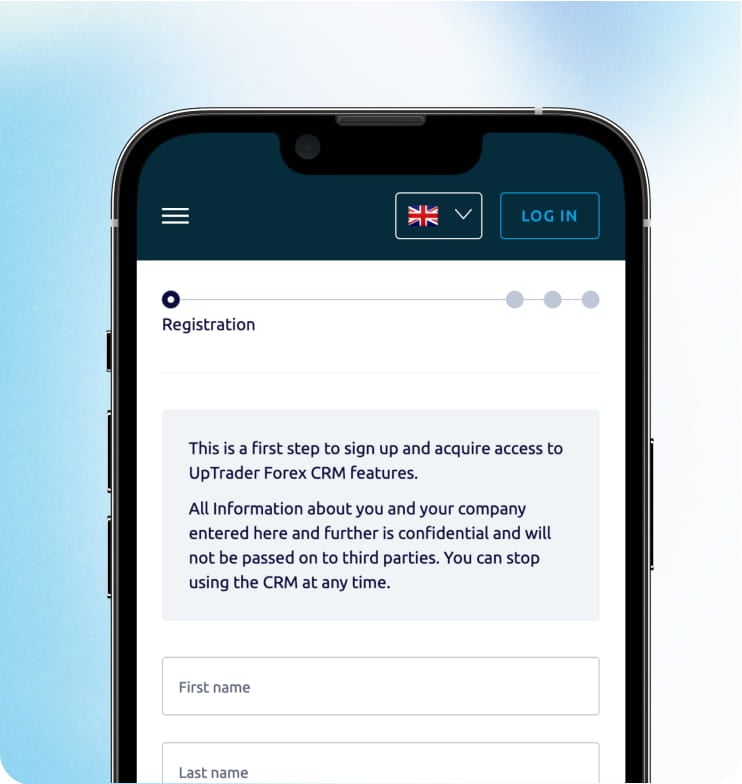
Many clients register, upload documents, check accounts and contact support from a phone. If document upload fails on a small screen or the client portal is hard to use on mobile, clients drop out at the most expensive point: just before they fund.
When evaluating Forex CRM, test the full journey on a phone: registration, document capture, verification status, deposit request and support chat. Measure completion rates by device if your analytics allow it.
Integration, Data Quality, and Interoperability
Forex CRM is only as useful as the data reaching it from trading platforms, payment providers, verification services and reporting tools. Whether an integration "exists" says little. What matters is which data flows are supported, in which direction, how quickly, what happens when an update fails, how errors are monitored and how records are reconciled.
The Operational Impact of Forex CRM Software
The effect of Forex CRM should be measured, not assumed. For each area below, record a baseline for at least one month before go-live, then compare the same metric after the system has settled.
|
Outcome |
KPI |
How to set a baseline and measure change |
|
Faster onboarding |
Median time from registration to approval |
Timestamp each stage before and after implementation |
|
Better conversion |
Registration-to-funded-account rate |
Track by month and acquisition source |
|
Payment visibility |
Share of transactions with a clear status at any time |
Sample transactions weekly and check status accuracy |
|
IB commission accuracy |
Disputes or corrections per payout cycle |
Log every correction with its cause |
|
Support efficiency |
Median resolution time |
Use ticket timestamps |
|
Retention monitoring |
Share of inactive clients contacted within a set period |
Define "inactive" first, then track follow-up |
|
Less manual work |
Hours spent on repetitive tasks per week |
Ask teams to log time for two weeks before and after |
|
Reporting quality |
Time to produce standard reports; number of manual adjustments |
Record preparation time per report |
Changes in these numbers can have other causes, such as new campaigns, market conditions or staffing. Compare like-for-like periods and note anything else that changed.
Compliance, Security, and Governance Considerations
Forex CRM software can support compliance work. It can enforce document collection, route KYC and AML checks to integrated providers, require approvals above set limits, record who did what, and produce reports. It cannot make a brokerage compliant on its own. Requirements depend on your jurisdiction and activities, whether you are supervised by the FCA, operate under MiFID II rules in the EU, or hold licenses elsewhere. Your compliance team and advisers decide what is required.
Areas to review with any vendor:
- Role-based access controls: who can see documents, approve payments or change client data.
- Audit-log coverage and retention: which actions are logged, and for how long the logs are kept.
- Data protection and residency: where personal data is stored and processed.
- Vendor security documentation: policies, certifications and recent assessments, with evidence.
- Integration permissions: the access rights each connected system holds.
- Incident response and recovery: how the vendor detects and reports incidents, and how quickly service is restored.
- Retention and deletion: how long client data is kept and how deletion requests are handled.
Challenges Brokers Should Plan For
|
Challenge |
Mitigation |
|
Legacy system integration |
Map every system the CRM must connect to before choosing a vendor, and ask for each integration's documented scope |
|
Inconsistent or duplicated client data |
Clean and de-duplicate records before migration, and define one unique client identifier |
|
Migration and data mapping |
Run a trial migration on a sample and reconcile it field by field |
|
Vendor dependencies and API limits |
Ask for API documentation and rate limits in advance, and agree who maintains each integration |
|
Security and access setup |
Design roles before go-live and review permissions after the first month |
|
Staff training and adoption |
Train each team on its own workflows, and appoint an internal owner per team |
|
Implementation and maintenance costs |
Price setup, integrations, custom work and support over at least three years |
|
Reporting and reconciliation gaps |
Schedule automated reconciliation between the CRM, payment providers and the trading platform |
How to Evaluate Forex CRM Software in 2026
Use this checklist when comparing forex CRM solutions:
- Supported trading platforms, and the exact scope of each integration
- Client onboarding flow and account provisioning
- Payment workflow visibility and reconciliation
- IB hierarchies, commissions and rebate rules
- Configurable workflows and automation
- Reporting, exports and analytics
- Security, permissions and auditability
- Deployment model and data residency
- API documentation and integration support
- Implementation timeline, migration, training and total cost of ownership
Questions to ask vendors:
- Which capabilities are native, configured, third-party or custom-built?
- Which events and data fields are synchronized, and in which direction?
- How are failed updates, duplicate events and reconciliation handled?
- What evidence can you provide for your security and uptime claims?
- Which costs are included in the quoted price, and which are charged separately?
Our guide to avoiding costly mistakes when choosing forex CRM software covers the selection process in more detail.
What Forex CRM Market Trends Mean for Brokers in 2026
Market forecasts point to continued growth in forex CRM software, but they disagree on size and say nothing about your brokerage specifically. Trends such as AI, mobile-first journeys and cloud deployment are worth understanding. Each one is still a set of trade-offs, not a requirement.
A better starting point is your own operation. Which processes cause the most manual work, delays or errors today? Which platforms and payment providers must the CRM work with? What do your regulators require? Where do you plan to expand? Prioritize the capabilities that address those answers, set baselines, and measure whether the change worked.
If you would like to see how UpTrader approaches these requirements, explore UpTrader's forex CRM, including its Sales Module and Forex Back Office, or request a product discussion through the same page.
Frequently Asked Questions
What is forex CRM software? A client and operations management system for brokerages that links acquisition, onboarding, trading accounts, partner management, support and reporting.
Why do forex brokers use specialized CRM software?
Generic CRMs are not built to link client records to trading accounts, payment workflows and IB commissions. Specialized software handles those connections with less custom development.
How much does forex CRM software cost?
It depends on the vendor's pricing model, client volume, number of platforms and servers, modules, setup fees, integrations and custom work. Among vendors that publish prices, entry points we reviewed in October 2026 ranged from USD 500 per month (UpTrader 1-Click Launch, 0 to 30 active clients) upward, while many vendors quote only on request.
What features should a forex CRM include?
Client and lead management, a client portal, trading-platform integration, payment workflows, IB management, reporting, and role-based permissions with audit logs.
Can forex CRM software integrate with MT4, MT5, cTrader, or other trading platforms?
Most forex CRMs support MT4 and MT5, and many support cTrader, DXtrade, Match-Trader or others. The depth of each integration varies, so ask which operations are supported per platform.
Does forex CRM software automate KYC and AML?
It can automate parts of the workflow, such as document collection, routing to verification providers and approval steps. The checks themselves usually come from specialist providers, and compliance decisions remain with your team.
Is cloud-based forex CRM better than on-premises software?
Neither is better in general. Cloud is usually quicker to deploy and maintain. On-premises gives more control but makes you responsible for infrastructure and security.
How can brokers measure forex CRM ROI?
Compare total cost over several years with measured changes in KPIs such as onboarding time, conversion, manual hours and commission disputes. Set baselines before implementation, and account for other changes that happened during the same period.
About the author