



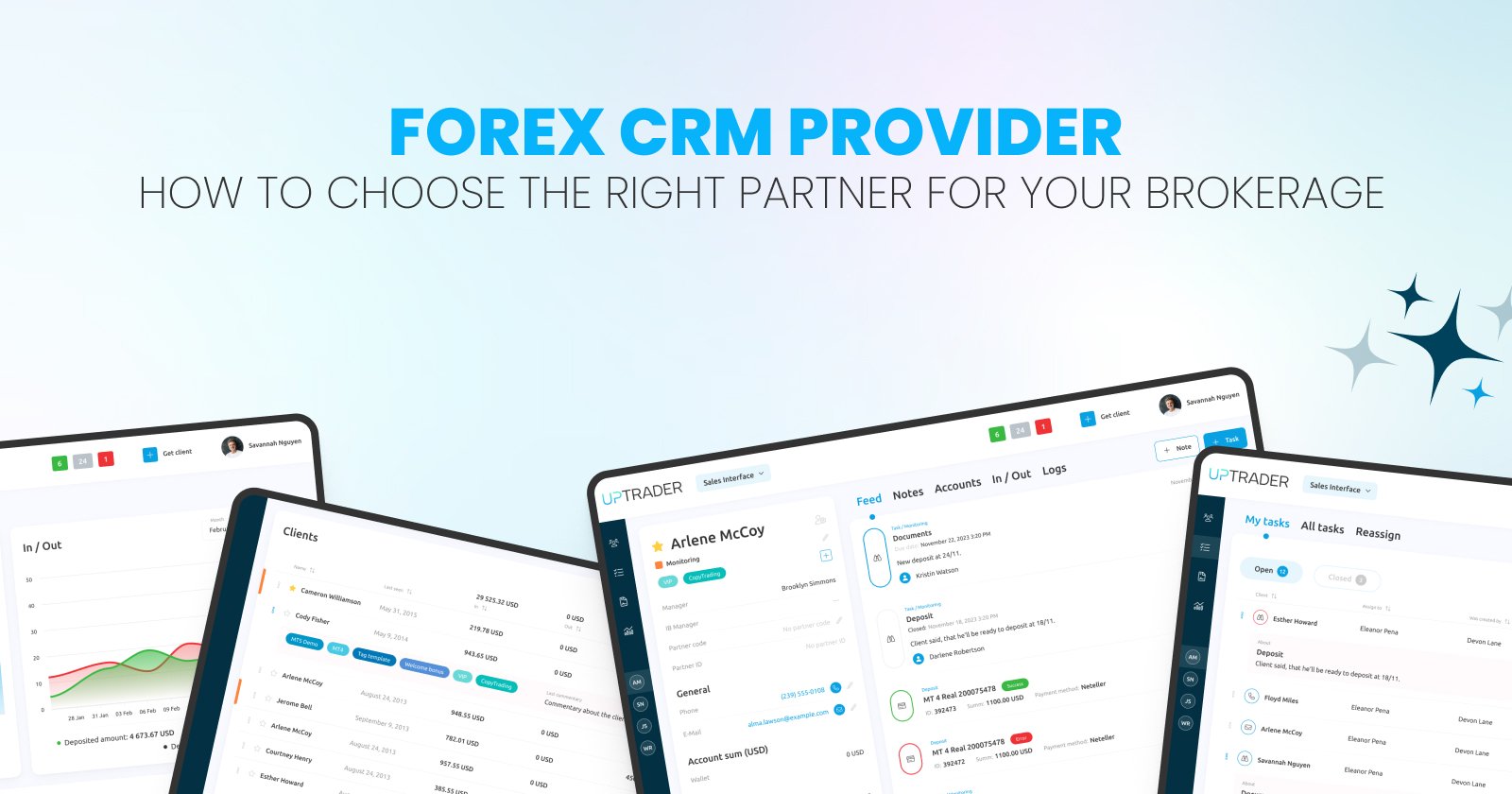
Forex CRM Provider: How to Choose the Right Partner for Your Brokerage
Share this publication:
As a forex brokerage owner (or future owner), selecting a Forex CRM is more than just a technical choice. It's a strategic choice that impacts your growth, operational efficiency, compliance, and satisfaction of your clients. A good Forex CRM provides you with the tools to scale, improves your lead conversion, and operational efficiency. The wrong one slows you down, frustrates your team, and costs you clients. This guide gives you a practical framework to choose a Forex CRM provider with confidence — and avoid expensive mistakes.
Why Your Forex CRM Provider Choice Matters
In the forex industry, you are selling trust, speed, and performance. Client expectations are seamless onboarding, swift deposit and withdrawal procedures, clear and uncomplicated reporting, and dependable customer service. Your Forex CRM is the system that connects all of this — from website registration to live trading accounts, IB payouts, and compliance reporting.
A strong Forex CRM doesn’t just store data. A good Forex CRM reduces manual labor and the possibility of human error, improves your conversion rates, provides you with insights and visibility, and automates business processes. In summary, your Forex CRM will become the backbone of your brokerage.
Start With Business Outcomes, Not Features
Before you compare vendors, define what success looks like for your brokerage. Most brokers make the mistake of chasing features instead of results.
Ask yourself:
- Do you want faster onboarding?
- Higher conversion rates?
- Better IB management?
- Stronger compliance controls?
- More accurate reporting?
Translate these needs into measurable goals:
- Reduce onboarding time by 50%
- Increase lead-to-funding conversion by 25%
- Automate 90% of payment reconciliation
No more manual IB commission calculations. These goals become your evaluation criteria.
Choose a Forex CRM Built for Brokerage, Not a Generic System
Not all CRMs operate the same. A generic CRM may facilitate contacts and email, but it will not know how to manage trading accounts, margin, leverage, or multi-tier IB commissions.
A forex-specific CRM should be able to handle:
- Trading Platform 4/5/cTrader integrations.
- Trading account lifecycle management
- Bonuses and promotion automation
- Multi-level IB structures
- Payouts to wallets and multi-currency balances
Having domain expertise will save you time, money, and operational risk.
Ensure Seamless Trading Platform and Payment Integration
Your Forex CRM should integrate with your trading systems. It should update sync trades, balances, and account statuses in real-time.
Ask vendors:
- Which platforms do you support natively?
- How often does data sync?
- Can the Forex CRM provide automatic deposits and withdrawals?
- Do you support multiple payment providers and wallets?
Poor integrations lead to errors in reconciliation, slow payouts, and unhappy customers.
Prioritize Compliance, KYC, and Risk Management
With the expansion of regulations, your Forex CRM needs to address the following: KYC Automation, Document Retention, A KYC, and prior reporting, along with regulatory compliance in specific territories.
With little to no Forex CRM resource allocation on compliance, the organization risks regulatory fines, the closing of accounts, and reputational damage.
Evaluate Sales, Marketing, and Lead Management Capabilities
Your Forex CRM should help convert leads, not collect them.. Focus on the ability to:
- Route leads and manage pipelines
- Track calls and log activities
- Attribute campaigns (UTM, source)
- Execute automated follow-ups and drip campaigns
- Reactivate dormant clients.
The more your Forex CRM automates the sales process, the more predictable your revenue stream will be.
Assess IB and Affiliate Management Tools
For many brokerages, introducing brokers is the most important.
Your Forex CRM must be able to manage
- Multi-Tier IB Structures and Custom IB Commission rules
- Automate IB Commission calculations
- Real-Time Reporting
- Transparency of IBs
Slow and error-prone Manual IB Payments damage trust and are a necessary consequence that automation must eliminate.
Demand Powerful Reporting and Business Intelligence
You cannot grow what you cannot measure. Your Forex CRM should offer:
- Real-time dashboards
- Custom report builders
- Scheduled exports
- API access for BI tools
You should be able to answer, at any time:
- Which campaigns perform best?
- Which agents convert the most?
- Which clients are most profitable?
- Where are you leaking revenue?
Verify Security, Hosting, and Reliability
You handle sensitive financial and personal data. Security is not optional.
Ensure your Forex CRM offers:
- Data encryption at rest and in transit
- Role-based access control
- Secure hosting in compliant regions
- High availability and uptime SLAs
- Regular backups and disaster recovery plans
Operational downtime equals lost revenue and broken trust.
Review Customization and Scalability Options
Your brokerage will evolve. Your Forex CRM must evolve with it.
Ask:
- Can workflows be customized without code?
- Can new features be added as your business grows?
- Can you white-label the interface?
- How fast can custom development be delivered?
A rigid Forex CRM will become a bottleneck as you scale.
Evaluate Implementation, Migration, and Support
A Forex CRM may be of high quality, but it will still fail if it is not properly implemented.
Look for:
- Onboarding roadmap
- Data migration support and testing
- Dedicated managers
- Ongoing support
- Technical support
- Training for your team
Before making your commitment, request a sandbox and a test run with example data.
Understand Pricing and Total Cost of Ownership
Do not evaluate price in isolation. Consider:
- Implementation costs
- Licensing costs, monthly or yearly
- Custom dev costs
- Support and maintenance fees
- Upgrade and scaling costs
For a period of 12-24 months, concentrate on the total cost of ownership instead of prioritizing the initial price.
Red Flags to Watch Out For
Assess vendors if they
- Don't give a demo or a sandbox
- Provide no explanation for integrations
- Features will be added “later”, but with no deadlines
- There is no migration plan Pricing is concealed with vague packages
These are risk signals
Build vs. Buy: Make the Smart Call
You should build only if your brokerage has highly unique regulatory or product requirements. Otherwise, buying a specialized Forex CRM gives you faster time-to-market, lower risk, and access to proven workflows.
Most successful brokers choose specialized providers rather than reinventing core infrastructure.
Final Decision Framework
Before signing:
- Define your business goals.
- Shortlist 3–4 forex-specific Forex CRM providers.
- Run identical demos and sandbox tests.
- Score vendors using your evaluation pillars.
- Negotiate phased delivery and SLAs.
- Choose the partner that maximizes long-term value, not just short-term savings.
If you are serious about establishing a scalable, profitable brokerage, and compliance needs, it’s time to partner with a Forex CRM that appreciates your business.
Schedule a custom demo with UpTrader today and discover how these solutions will simplify your operational processes, enhance your conversion rates, and speed up your growth.