


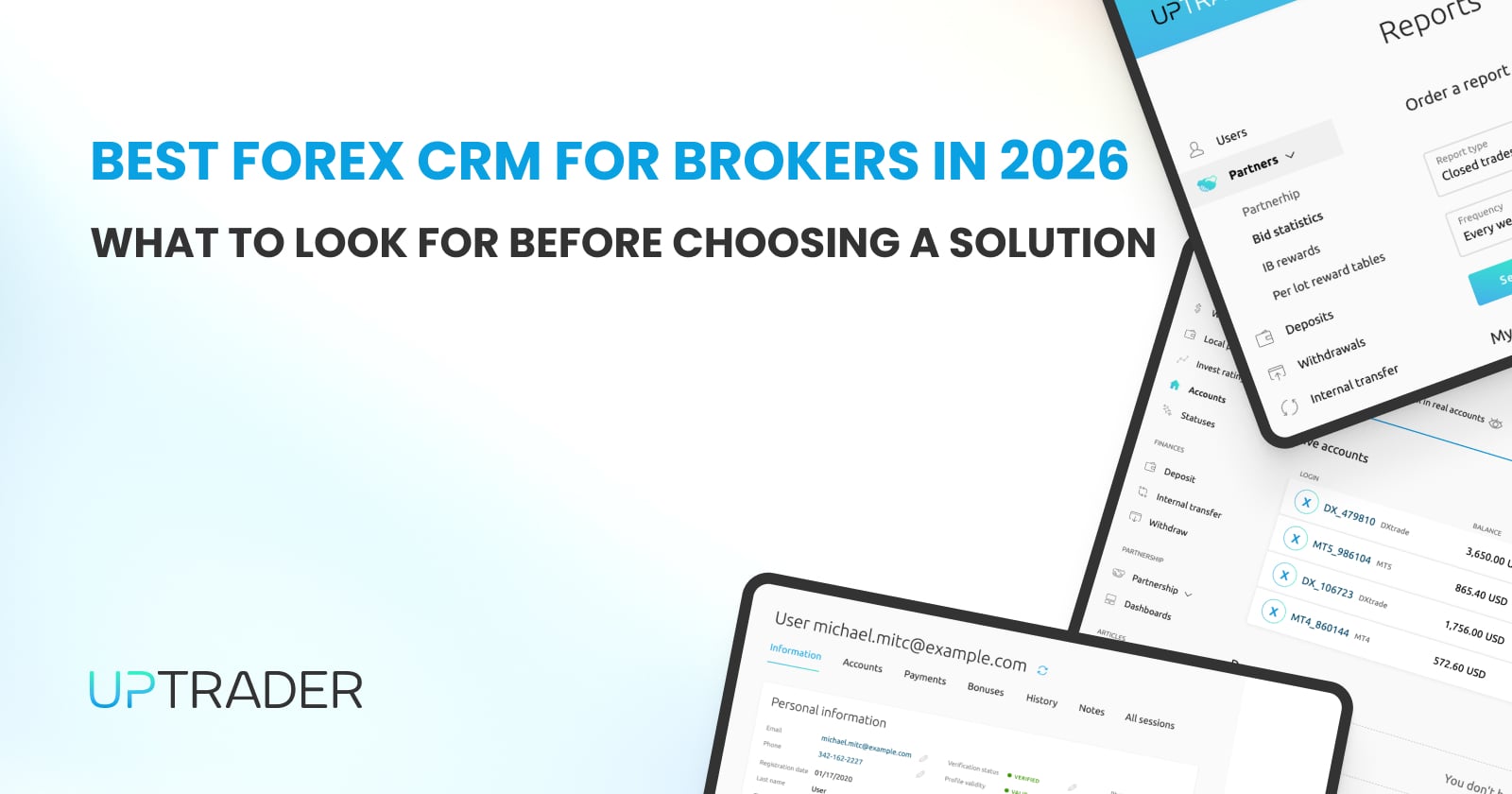
Best Forex CRM for Brokers in 2026: What to Look for Before Choosing a Solution
Share this publication:
There is no single best forex CRM. That statement might seem counterintuitive in an article with this title, but it is the most honest starting point for this conversation. A startup brokerage launching its first 500 accounts has different infrastructure needs than a scaling operation managing 10,000 clients across three jurisdictions with a 200-partner IB network. The Forex CRM that is perfect for one will create operational bottlenecks for the other.
What does exist is a set of evaluation criteria that will reliably separate platforms built for brokerage operations from platforms that look capable in a demo but fall apart under production conditions. The brokers who choose well know what questions to ask before they see a single product walkthrough. The ones who choose poorly compared feature lists, picked the longest one, and discovered six months later that feature count has nothing to do with operational fit.
This article covers what to evaluate, what to pressure-test, and what to watch out for before you commit to a Forex CRM you will depend on for years.
For the Best Forex CRM Start With Your Operating Model, Not the Vendor's Feature List
The most common mistake in CRM selection is starting with the product instead of starting with your own operations. Before you look at a single vendor, you need to map out how your brokerage actually works on a daily basis.
How do leads reach you, and how are they assigned? What does your onboarding and KYC flow look like, and where are the current bottlenecks? How many payment service providers do you use, and how does fund reconciliation work today? Do you run an IB program, and if so, how complex is your commission structure? Which trading platforms do you support? Do you operate multiple brands or jurisdictions from a single entity?
These questions define your requirements. A brokerage that acquires clients primarily through a multi-tier IB network needs a CRM with deep partner management capabilities and real-time commission computation. A brokerage that relies on direct paid acquisition needs strong lead scoring, automated nurture sequences, and conversion tracking. A brokerage operating under multiple regulatory licenses needs jurisdiction-configurable compliance workflows. The "best" CRM is the one that matches the way your specific brokerage operates, not the one with the most impressive marketing page.
Trading Platform Integration Depth
Every forex CRM vendor will tell you they integrate with Trading Platform 4 and 5. What they do not always tell you is how deep that integration goes, and that distinction matters enormously.
Surface-level integration means the Forex CRM can create trading accounts and maybe pull basic balance data. Deep integration means real-time synchronization of account balances, open positions, margin levels, deposit and withdrawal activity, and trading behavior. It means your sales and retention teams can see a client's live trading data directly inside the Forex CRM record without switching to a separate admin panel. This allows for automatic workflows to be triggered by a trader's activity through Forex CRM, such as flagging a trader whose volume has been reduced by 50% over the past two weeks, as an example.
When assessing vendors, request to see the integration running on either live or staging and not only on paper. Ask whether the integration uses the Trading Platform 4 or 5 Manager API natively or relies on middleware. Ask what happens to Forex CRM data when the trading server restarts. Ask whether the integration supports cTrader, DXtrade, or MatchTrader if those platforms are on your roadmap. These details determine whether your team can actually use the Forex CRM as a single operational view or whether they will still be toggling between systems.
Compliance Infrastructure, Not Just a KYC Checkbox
Compliance is one of the areas where the gap between vendor claims and operational reality is widest. Almost every Forex CRM will advertise KYC and AML support. What you need to evaluate is whether that support is a configurable workflow engine or a basic document upload form with a status dropdown.
A broker-grade compliance module should let you configure jurisdiction-specific document requirements, risk scoring rules, and approval workflows without developer intervention. It should route clean submissions to auto-approval and flag discrepancies for manual review with the specific issue identified. It should maintain a complete audit trail for every client: who reviewed their documents, when, what decision was made, and what evidence supported it.
The compliance question you should ask during every vendor evaluation is this: if a regulator asks you to demonstrate your KYC approval process for a specific client from six months ago, can the Forex CRM produce that trail in under 60 seconds? If the answer involves exporting data to a spreadsheet or searching through email threads, the system is not audit-ready.
Brokerages operating across FCA, CySEC, ASIC, or other major jurisdictions need the ability to run different compliance workflows per jurisdiction from a single Forex CRM instance. If expanding into a new market requires deploying an entirely separate system, your CRM will become a scaling constraint rather than a scaling enabler.
IB and Partner Management at Scale
If you run an Introducing Broker program, your Forex CRM's partner management module is not optional. It is a revenue infrastructure component.
At low scale, IB management is simple. A handful of partners, flat commission structures, monthly payouts calculated in a spreadsheet. At growth scale, it becomes one of the most complex workflows in your brokerage. Multi-tier hierarchies where sub-IBs sit under parent IBs with negotiated rates. Hybrid models combining CPA for first deposits with ongoing rebates on trading volume. Real-time accruals that partners expect to see without waiting for month-end reports.
Evaluate whether the Forex CRM computes commissions automatically based on confirmed trade data or whether your team needs to run manual calculations. Ask whether partners get a self-service portal where they can monitor their network, track referrals, and see earned commissions in real time. Ask how the system handles commission disputes when a partner disagrees with a payout calculation. Automated, traceable commission management is one of the clearest differentiators between a CRM that was built for forex operations and one that was adapted from a generic sales tool.
Wallet Architecture and Payment Operations
Payment processing is operationally critical and often under-evaluated during CRM selection. Your Forex CRM handles every deposit, every withdrawal, every internal transfer, and every refund. The way it structures that data determines whether your finance team spends hours or days on reconciliation each month.
The architectural question to ask is whether the Forex CRM uses a single-wallet ledger system, where every fund movement is recorded as a discrete traceable event tied to a client identity and a timeline, or whether it tracks balances per account or per PSP independently. The first approach gives you a clean, auditable financial record. The second fragments your data and creates reconciliation gaps that grow with volume.
Beyond architecture, evaluate the breadth of PSP integrations available out of the box. Bank wire, credit card, e-wallet, and cryptocurrency payment options are baseline expectations in 2026. If your target markets include Southeast Asia or MENA, verify that the Forex CRM supports the specific local payment methods your clients will expect.
The Client Portal Question
Your Forex CRM selection and your trader room decision are often the same decision. Many purpose-built forex CRM platforms include an integrated client portal as part of their offering. An integrated trader room that shares the same data layer as your CRM back office eliminates synchronization issues. What the client sees in their portal matches what your team sees internally. Deposit statuses, KYC progress, account balances, and IB attribution stay consistent across both interfaces.
If the Forex CRM you are evaluating does not include a client portal, factor in the cost and complexity of integrating a third-party trader room. That integration requires real-time data sync, consistent authentication, and shared wallet visibility. Underestimating that effort is one of the more expensive surprises brokers encounter after committing to a CRM.
What to Pressure-Test During Demos
A demo is a controlled environment designed to make the product look good. Your job is to break that control and see how the system behaves under realistic conditions.
Ask to see the onboarding flow end to end, from registration through KYC approval to first deposit. Ask the vendor to demonstrate a withdrawal approval workflow with compliance checks. Ask to see IB commission calculations for a multi-tier hierarchy with different commission types. Ask what happens when 50 KYC submissions arrive simultaneously. Evaluate based on what the platform lets you do under pressure, not what it shows you in a scripted walkthrough.
Conclusion
The best Forex CRM for your brokerage in 2026 is not the platform with the most features, the most integrations listed on its website, or the most polished demo. It is the one that fits your operating model, handles your compliance requirements natively, integrates deeply with your trading platforms, scales your IB program without manual workarounds, and gives your finance team a clean ledger that reconciles without friction.
Start with your operations. Define your requirements before you see your first product demo. And evaluate based on architectural fit, not feature count. The Forex CRM you choose will shape how your brokerage operates for years. Make the decision accordingly.
UpTrader provides a purpose-built forex CRM with integrated trader room, automated IB management, multi-currency wallet architecture, and deep Trading Platform 4, 5, and cTrader integration.
Request a demo and see how UpTrader fits your operating model here